
“Eri Asks” is an interview series in which Eri Takane, Fair Director of Tokyo Gendai, speaks with artists and key figures from Japan and around the world.
For this edition, we meet artist Ryan Gander, whose practice continually expands the possibilities of art by bringing together humor and intellect, often starting from everyday scenes and familiar objects. Working across sculpture, installation, performance, and a wide range of other mediums, Gander deliberately leaves space within his works for the viewer’s imagination, creating worlds that remain open to countless interpretations rather than leading to a single answer.
Ahead of the presentation of his new work, Your Questions in a World that Only Wants Answers, at Tokyo Gendai, Gander speaks with Eri Takane about the power of art to generate not answers, but questions. We hope you enjoy the conversation.
©Ryan Gander Courtesy of TARO NASU
“Art Is Not About Arriving at a Single Answer”
Eri Takane (Eri): I’d like to begin by asking about the fundamental ideas that underpin your practice as an artist. Is there a central message or philosophy that you hope to convey through your work?
Ryan Gander (Ryan): That’s a very big question. Actually, I don’t have a clear objective or mission that I’m trying to accomplish. I’m not making work toward some predetermined goal. I simply continue to make things in my own way.
That said, two qualities that are often associated with my work are a sense of accessibility and a sense of intrigue. I think that comes from the fact that I deliberately leave something missing from my work.
I intentionally leave gaps and empty spaces. Something might never have existed, or it might have been removed or erased. I think those absences allow viewers to project their own thoughts, stories, and experiences into the work.
So, in a sense, what I create is a framework or a starting point. Different people come to it and bring their own ideas with them. The art I love is art that starts in one place and ultimately arrives at a million different places.
Conversely, I’m not particularly interested in work that starts in one place and leads everyone to exactly the same destination. To me, that’s more like communication than art. If you want to communicate a clear message and have people understand it precisely, you don’t need to use art. I think art is less about communication and more about “misunderstanding.”
Because it isn’t explicit, different people can read it in different ways. And the more people who interpret it, the richer the work becomes. That’s how I see it.
What Makes an Artist an Artist?
Eri: Are there any artists who have inspired you or made you think, “I want to make work like that”?
Ryan: Of course there are. But I’d rather not name any names. What draws me in is art that makes you think, rather than simply something to look at. I’m not particularly interested in work that focuses solely on how visually beautiful it is. I’m much more interested in the experience than in the image itself.
For me, the best art is something you feel. That’s why I’m drawn to architectural installations, performance, intervention-based works, works with a strong narrative element, and works that unfold over a period of time.
Art, fundamentally, should be capable of becoming anything in the world. You could invent a ball game. You could choreograph a ballet performed entirely by animals. You could design a restaurant menu. All of those things could be art. And yet 99 percent of the art being made in the world is square, flat, and hung on a wall. I find that incredibly strange.
We live in a world where you can do anything, break the rules, and experiment freely. So why does everyone end up doing the same thing? That’s why I’m drawn to artists who defy established expectations.
When you go to an exhibition and find yourself thinking, “This is completely different from the artist’s previous work,” or, “I never imagined this artist would make something like this,” that sense of surprise is what I think makes a great artist.
Making Art That Doesn’t Look Like Art
Eri: I’ve seen your work before at museums in Osaka and in Dazaifu, Fukuoka. At first glance, your work often feels humorous, bright, and very approachable. But as you learn more about the work, you discover extremely complex ideas and concepts underneath. Is that sense of accessibility something you create intentionally?
Ryan: That’s an interesting observation. For me, it’s about finding a balance between seriousness and being engaging. There’s an idea that is deep and interesting enough to stay in your head for weeks, but there’s no answer to it. And then, on the other side, there’s accessibility.
Contemporary art and conceptual art are often seen as difficult, as something only people with specialized knowledge can understand—as though you need to study at university for ten years before you can make sense of it. But that’s simply an assumption. Anyone can have their own interpretation of any work of art.
So I don’t think it’s enough to simply make something very serious and interesting. You need some kind of mechanism that allows the viewer to enter the work naturally.
For me, that sometimes means making something that almost declares, “This is not art.” Imagine I made a small mouse. A child looking at it wouldn’t necessarily think, “That’s art.” They would simply think, “It’s a mouse.” And that’s important to me.
When people encounter something that looks like “art,” they immediately become guarded. But if something doesn’t look like art, they can engage with it naturally at first. And then, later, they might realize, “Oh, this was art all along.” That’s why I’m very interested in making art that doesn’t look like art.
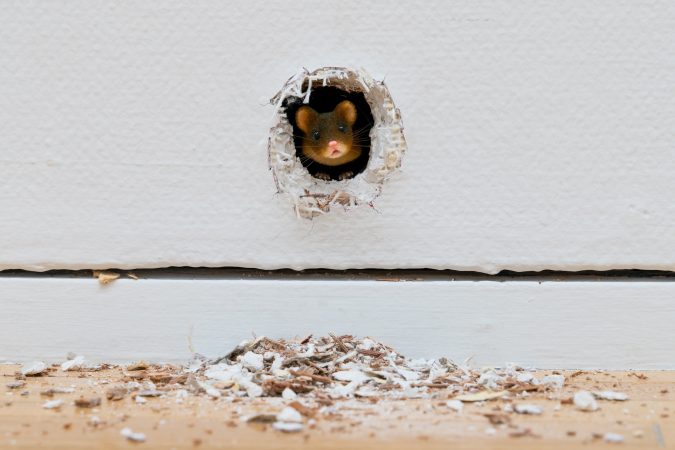
©Ryan Gander Courtesy of TARO NASU
Installation view at Tokyo Opera City Art Gallery, 2022
Collection of Ishikawa Foundation, Okayama
Photo: Tomoki Imai
Where Do Ideas Come From?
Eri: Everyday objects and things from ordinary life often appear in your work. We live in a time when there is an overwhelming amount of information, and it can be difficult to know what to draw inspiration from or how to select the ideas that are worth pursuing. How do you gather ideas in your daily life?
Ryan: I have my own habits, or what you might call a creative routine.
I spend more than half the year traveling, so I’m not the kind of artist who stays in the studio all the time. Sometimes I’m in London, sometimes in Salzburg, and sometimes I go to my studio in the countryside near the sea. So my practice is quite nomadic. I’ve built my life around being able to continue making art wherever I am.
For example, today I’ve been taking photographs and writing down thoughts in a notebook throughout the day. Then, when I return to my studio in the countryside, I turn those ideas into cards. I have a room called the “Idea Room,” where I put all of these cards up on the walls. There are hundreds of them, each representing an idea that could become the starting point for a project or exhibition.
When I’m thinking about a new project, I go into that room, move the cards around, and start combining them. That’s how I work out what I’m going to make, how I’m going to make it, and how an exhibition might come together.
A lot of the other things I work on—clothing design, music videos, television programs—also come out of that room. It looks a bit like the investigation room of a serial killer in a movie. There’s information covering the walls, and it’s almost a little frightening.
Actually, I’m planning an exhibition where the room itself will be recreated inside a museum. So I’ll be letting everyone steal my ideas.
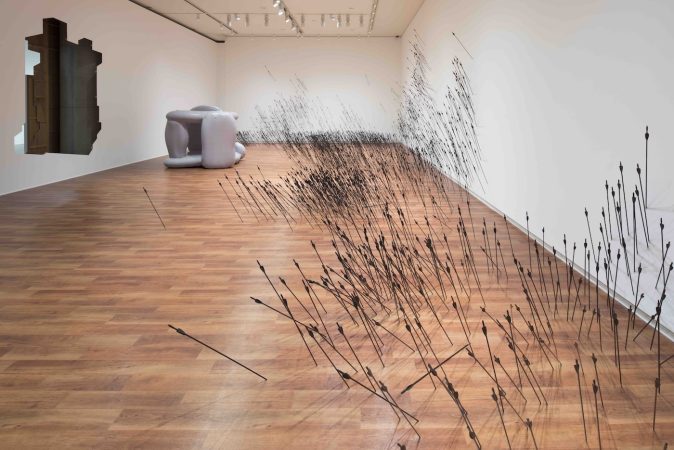
Installation view at National Museum of Art, Osaka,2017
Photo: Nobutada Omote
Work That Keeps Changing, and What Remains the Same Beneath It
Eri: You’ve made an extraordinary number of works and presented them around the world. Looking back over the past 10 or 20 years, do you feel that your work has changed? Or is there something fundamental that has remained the same?
Ryan: Honestly, I’ve never really thought about it. I think my work changes constantly from one piece to the next. But I do have a sense that I’m still doing, in different ways, things that I was doing 10 or 20 years ago.
For many artists, their trajectory gradually shifts direction over time, something like this. But for me, it’s more like this. Each work moves off in a completely different direction. What hasn’t changed, though, is the essence of making the work itself.
If you look at artists like Picasso, for example, many artists evolve over time—not only in the work itself, but also in the ideas and principles underlying it. In my case, I think the core remains the same, while the appearance and methods of each work are completely different.
There’s also something therapeutic about making art for me. It forces me to think about things I wouldn’t normally think about, so in a way, it feels like going to therapy or having a counseling session.
Eri: So, mentally, would you say you’re in roughly the same place now as you were 10 years ago?
Ryan: If anything, I think making art is what helps me maintain my mental stability.
My mind probably works a little too quickly (laughs). I’m not particularly good at focusing on just one thing, so I need lots of things to be happening simultaneously. In fact, I feel calmer when my mind is busy. When there’s nothing to do, I get anxious. So, strangely enough, I’m actually happiest when I’m incredibly busy.
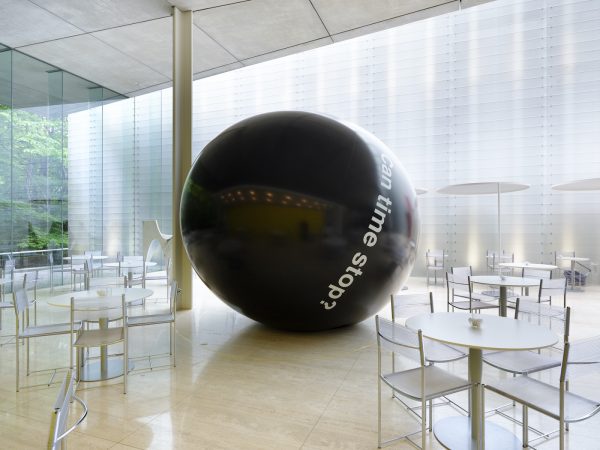
©Ryan Gander Courtesy of TARO NASU
Installation views at Pola Museum of Art, Hakone, 2025
Photo: Shu Nakagawa
Asking Questions in a World That Only Wants Answers
Eri: You’ll be presenting a large-scale sculpture at Tokyo Gendai this time. Could you tell us a little about the work?
Ryan: The work is part of a series that grew out of a research project called Your Questions in a World that Only Wants Answers. It began when one of my children asked me to come to their school’s art club. When I went there, I heard a teacher telling the students, “Stop daydreaming and concentrate.” I thought, “That’s strange.” I thought daydreaming was exactly what children should be doing.
At another point, I told the children, “You can be more silly.” Because art comes from being silly and playing. The teacher asked me, “Why are you letting them do that?” And I said, “Because it’s an art class”.
When I got home, I talked about it with my daughter Penny. She said, “I don’t like school. School just wants you to memorize answers.” And then she said, “But we have smartphones now, so you don’t need to memorize the answers. You can just look them up.”
That really made sense to me. We don’t necessarily need to remember everything. Any information we need can be looked up at any time. She also told me that her teachers were always telling her to stop asking questions.
That got me thinking about education. In Europe and the United States, there is still a strong educational model based on memorizing the “correct” answers. But machines are incredibly good at storing and retrieving information.
So I started thinking: What is something only humans can do? And I thought, humans can ask “stupid questions.” Machines don’t ask stupid questions. So perhaps education should be less about memorizing answers and more about encouraging children to ask stupid questions.
And answers become outdated very quickly. The moment you learn something, the world has already moved on. That’s why I started collecting questions.
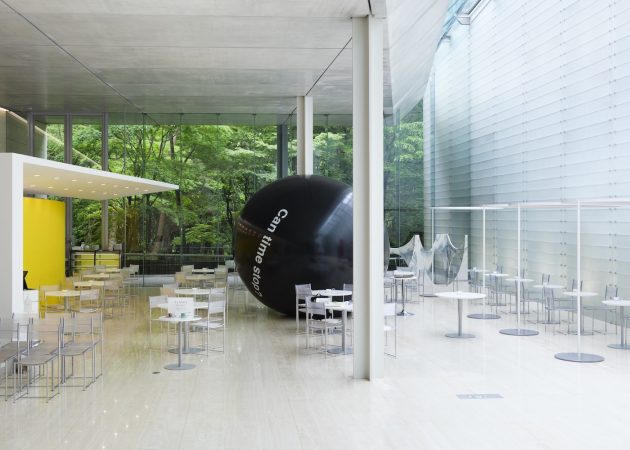
©Ryan Gander Courtesy of TARO NASU
Installation views at Pola Museum of Art, Hakone, 2025
Photo: Shu Nakagawa
“The Power of Art Is to Generate Countless Questions, Not a Single Answer”
Ryan: I began collecting questions that didn’t have clear answers. I gathered them from friends, children, people who think abstractly, people with a sense of humor, logical thinkers—people of all kinds. In the end, I collected around 2,000 questions.
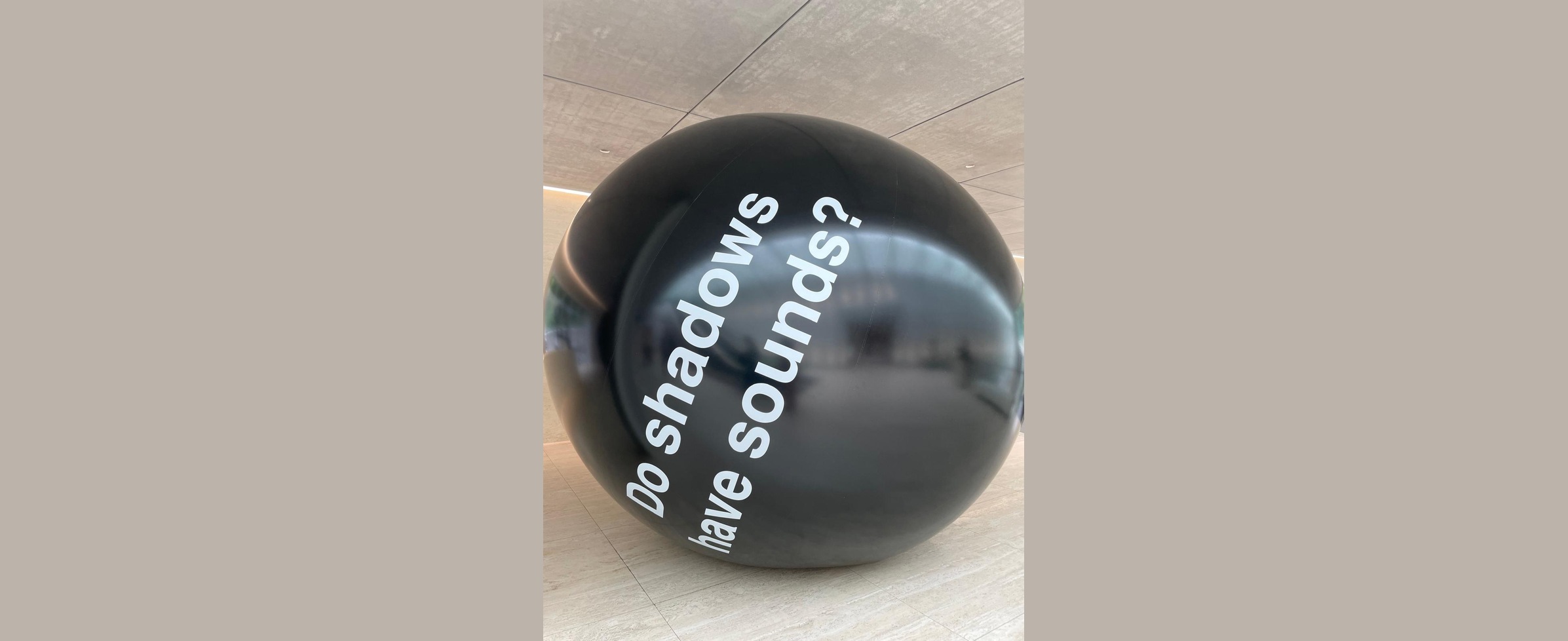
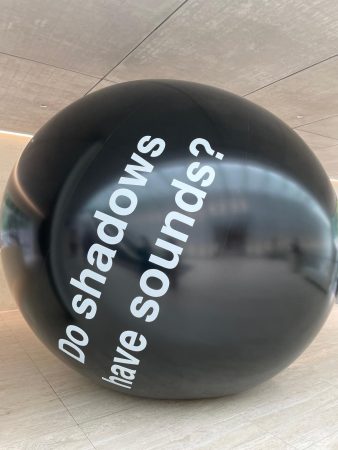
Then I turned those questions into a huge ball. I wanted to give questions a physical presence.
Questions are normally invisible. But when you turn them into a gigantic ball and place it in a space, the questions physically become “there.” And because it’s enormous, it gets in the way. There’s this huge question sitting in the middle of the room, and you have to squeeze your body through the space beside it to get past.
It’s almost as if the question itself is standing in your way.
For example, one of the questions is, “Do ghosts have teeth?” There’s no way to answer it. But it’s a fantastic question. Another is, “Do fish float?” The philosopher André Gide wrote about how, when a fish dies, it floats to the surface, while when a human dies, they fall to the ground. So does that mean that what is “down” for a fish is “up” for us? That’s the kind of question I’m interested in.
Eri: Did you collect all 2,000 questions by asking lots of different people?
Ryan: The 2,000 questions came from around 100 people. I wrote quite a lot of them myself, and an artist named Simon, who works with me in the studio, contributed many as well. It was a kind of collaborative process—everyone creating questions together.
Eri: I’d love to see this become a public project someday.When I was growing up, Japanese education also strongly emphasized the idea that there was a correct answer to everything. Even in art classes or writing assignments, we were expected to find the answer.
Ryan: Exactly. If there were a book containing only questions, I’d much rather read that than a book containing questions and answers. Because without the answers, it remains open.
As I said at the beginning of our conversation, the art I love is art that starts in one place and ends up in a million different places.
If 100 people encountered a work asking, “Do ghosts have teeth?”, all 100 would think about it differently. They wouldn’t all arrive at the same conclusion. I think that’s where the power of art lies.
The power of art is not to provide a single answer, but to open up countless directions. For that to happen, the work has to remain open. It shouldn’t be didactic, and it shouldn’t be superficial. There needs to be enough space for the viewer to bring their own thoughts and ideas into it.
Eri: It’s a very exciting work for Tokyo Gendai. Will you be coming to Tokyo?
Ryan: Yes. I’ll come to Tokyo for one night first to see a friend, then I’ll go to Seoul for a project at Frieze. After that, I’ll come back to Tokyo. It’s right around the time of the art fair, isn’t it?
Eri: Tokyo Gendai runs from September 10 to 13.
Ryan: Then I’ll come on the 10th. You’ll send me an invitation, right?
Eri: Of course. We also have our VIP program on the 10th, so please do join us.
Ryan: I’m looking forward to seeing everyone in Tokyo.
Thank you very much!
Come find the story hidden in plain sight.
Dates:
11-13 September 2026 (Fri-Sun) *Vernissage: 10 September (Thu)
Venue:
Pacifico Yokohama
Booth:
TARO NASU
Ticket Purchase:
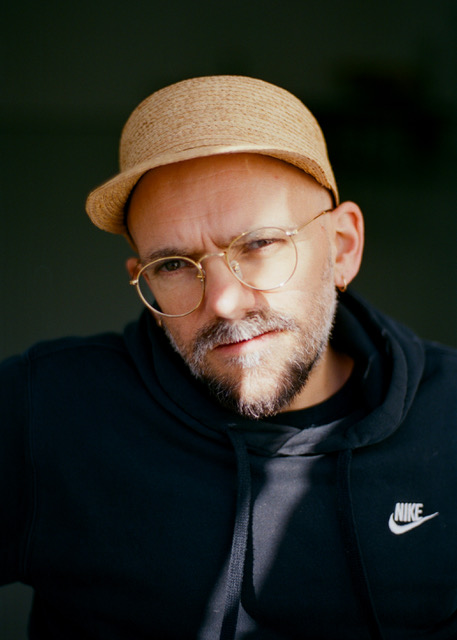
RYAN GANDER OBE RA
1976 Chester, UK.
Ryan Gander has established an international reputation through artworks
that materialise in many different forms, ranging from sculpture, apparel and
writing to architecture, painting, typefaces, publications and performance. As
well as curating exhibitions, he is a committed educator, having taught at
international art institutions and universities, and has written and presented
television programmes on and about contemporary art and culture for the
BBC.
Through associative thought processes that connect the everyday and the
esoteric, the overlooked and the commonplace, Gander’s work involves a
questioning of language and knowledge, as well as a reinvention of both the
modes of appearance and the creation of an artwork. His work can be
reminiscent of a puzzle, or a network with multiple connections and the
fragments of an embedded story. It is ultimately a huge set of hidden clues to
be deciphered, encouraging viewers to make their own associations and
invent their own narrative in order to unravel the complexities staged by the
artist.
Ryan Gander is an artist living and working in London and Suffolk. He studied
at Manchester Metropolitan University, UK, the Rijksakademie van Beeldende
Kunsten, Amsterdam, NL and the Jan van Eyck Akademie, Maastricht, NL.
The artist has been a Professor of Visual Art at the Universities of
Huddersfield and Suffolk and holds an honorary Doctor of the Arts at the
Manchester Metropolitan University and the University of Suffolk. In 2017 he
was awarded an OBE for services to contemporary arts. In 2019 he was
awarded the Hodder Fellowship at Princeton University. In 2022, he was
made RA for the category of Sculpture. Since 2024, he has held the position
of Professor of Perspective at the Royal Academy Schools, London, UK.