
Working within the centuries-old tradition of Japanese woodblock printing, Seiko Kawachi creates works that resonate with a strikingly contemporary presence. Through a deep engagement with wood—the material at the heart of Japanese artistic sensibility—he explores an inverted world in which left and right are reversed, revealing unseen perceptions and expressing the expansive vision of the universe that has shaped his own experience.
In this interview, Kawachi reflects on his profound respect for masters such as Hokusai and Hiroshige, the sense of movement and vitality embodied in his celebrated Wave series and Mount Fuji works, and the dialogue between his woodblock prints and the oil paintings presented in this exhibition. We invite you to experience the remarkable power of each work and discover how Kawachi reimagines the language of traditional woodblock printing for the present day.
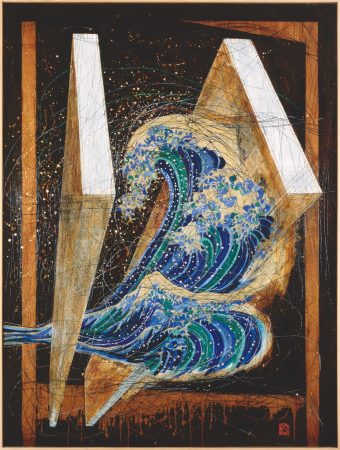
Although you work with the traditional medium of woodblock printing, your work feels strikingly contemporary and full of energy. For someone encountering your work for the first time, how would you describe your artistic practice?
Since I was around seventeen years old—when I first began to imagine that painting might become my life’s work—I have been preoccupied with a single question: “Who am I?” That question has led me through a continuous process of trial and exploration. As someone born in 1948, belonging to Japan’s postwar baby boom generation, I have consistently sought ways to express both the intensity of the era I have lived through and my own inner landscape.
I consider traditional Japanese woodblock printing to be one of the most refined techniques to have emerged from Japan’s cultural heritage. Wood, as a material, is closely aligned with the Japanese sensibility, and the medium itself is deeply connected to the origins of Japanese art, as seen in ukiyo-e. Printmaking also functions like a mirror, reflecting both the external world before us and the inner worlds within us.
By carving and printing in reverse—flipping front and back, left and right—I enter an inverted realm. In that process, what is usually unseen begins to surface, along with unfamiliar modes of perception. That, to me, is one of the profound fascinations of printmaking.
My work in water-based woodblock printing draws upon the sensibility of my generation, my own cosmological vision, and the space that exists in the present moment. At once bold and delicate, quiet yet intense, I continue to explore my understanding of the universe and of life through these layered expressions.
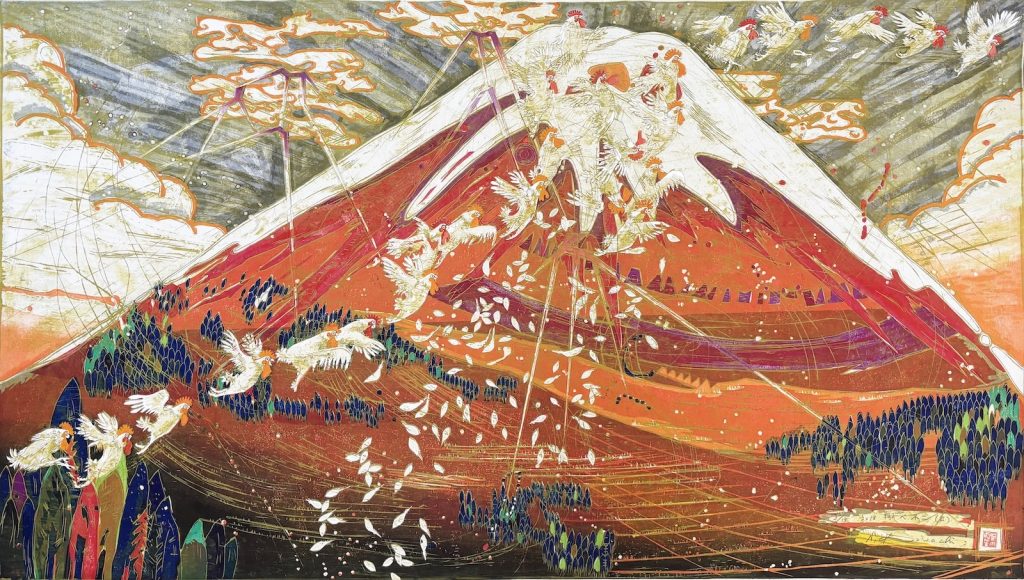
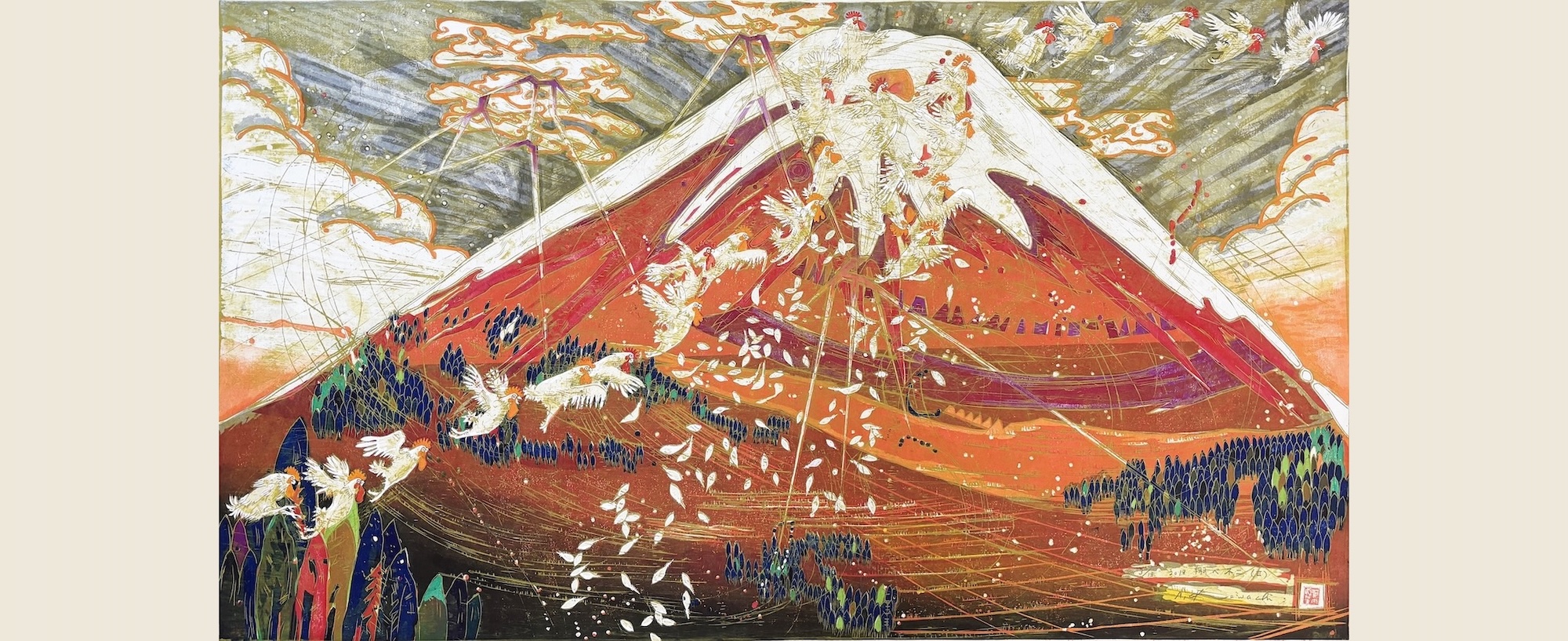
In your celebrated Wave series and your Mount Fuji works, motifs associated with masters such as Hokusai and Hiroshige are reinterpreted through a contemporary lens. When transforming these icons of Japanese visual culture into expressions of present-day vitality, what is most important to you?
Above all, it begins with profound respect for those who came before us.
Hokusai and Hiroshige achieved an extraordinary abstraction of the Japanese landscape. Even in their own time, they were creating compositions of remarkable simplicity and refinement. Their work embodies the very origins of Japanese aesthetics, while also expressing a universal sensibility that continues to resonate today.
For me, what matters is not simply repeating their forms. Rather than depicting the landscape exactly as they saw it, they expressed something far greater: the imagination of humanity, inner landscapes, and even the worlds of myth and legend that arise from a place. In the same way, I do not seek to reproduce what I see. I want to absorb it, allow it to settle within me, and then express what re-emerges through my own contemporary sensibility.
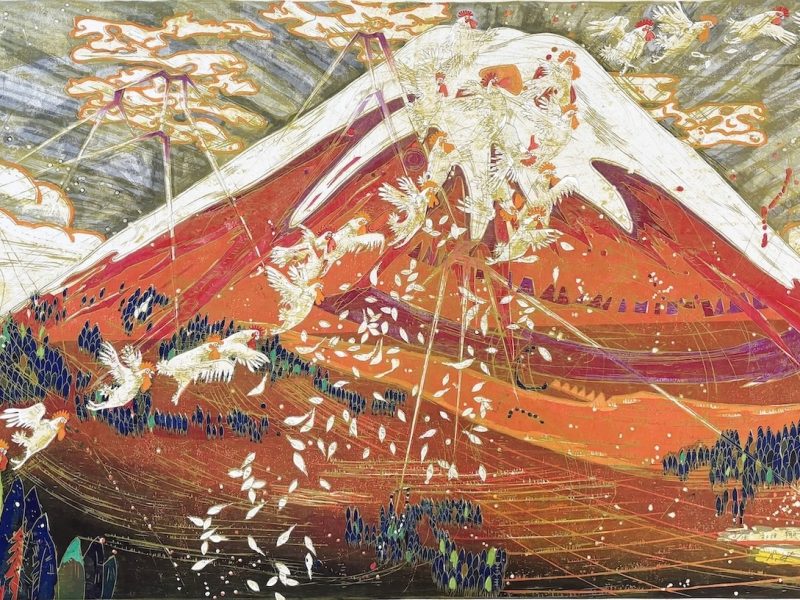
The same is true of my Mount Fuji series. At first, I regarded Mount Fuji as an overly familiar, almost clichéd motif. Yet the more seriously I engaged with it, the more it compelled me to reflect on what it means to be Japanese and what Japanese culture truly is. Mount Fuji possesses an immense symbolic force—it is the origin of Japan’s collective imagination and a source of its cultural identity.
With deep respect for artists such as Hokusai and Hiroshige, I hope to transform that enduring spirit into a contemporary vitality through my own woodblock prints.
This presentation also includes oil paintings such as Poem of the Universe (Song of Expansion). How do these paintings resonate with the expressions that emerge through the processes of carving and printing in your woodblock practice?
In my work, I write the character for “universe” (uchū), but I prefer to read it as hirogari, meaning “expansion” or “boundlessness.” For me, the universe is not simply a distant expanse of space. It encompasses life and death, nature, time, and even my own existence. Since I first began making prints, this sense of the cosmic has remained a constant source of inspiration.
The processes of carving and printing are among the most enjoyable aspects of my practice. Printmaking is a way of reflecting the world like a mirror, reversing front and back, left and right. As I think through each stage and work with my hands, unexpected images begin to emerge. I hold on to those discoveries, allowing them to evolve into drawings and oil paintings.
In turn, ideas that first appear in a painting or drawing often find their way back into a new woodblock print. Rather than existing as separate practices, printmaking, painting, and drawing form a continuous creative cycle. The images born in one medium naturally transform into another. Through the different acts of carving, printing, and painting, each process resonates with the others, gradually deepening my own sense of hirogari—of expansion.
The rhythm and vibrant color in your work seem to overflow beyond the picture plane. Where do you find your greatest sources of inspiration?
Nature and my sense of the universe are probably my greatest sources of inspiration. Reflecting on the Earth within the universe—and my own place within the Earth—has always been central to my practice.
When I was young, I saw 2001: A Space Odyssey, and I was overwhelmed by the sheer scale of human imagination. Ever since then, I have wanted to express something of the cosmic in my own work.
My interests extend beyond art. I have long been fascinated by architecture and mathematics as well. Just as mathematicians seek to understand the structure of the universe through equations, I hope to pursue my own vision of the universe through woodblock printing.
I believe that the foundations of beauty are shared across art, science, and religion. At some fundamental level, they are all connected through nature and the cosmos.
At the same time, I continue to draw inspiration from the emotions people seek to share with one another, and from the extraordinary artistic achievements left to us by those who came before. Artists such as Hokusai, who devoted themselves to their work until the very end of their lives, continually inspire me through their unwavering pursuit of an ideal.
Nature, the universe, human emotion, and the legacy of earlier artists—all of these converge to shape the rhythm and color of my work.
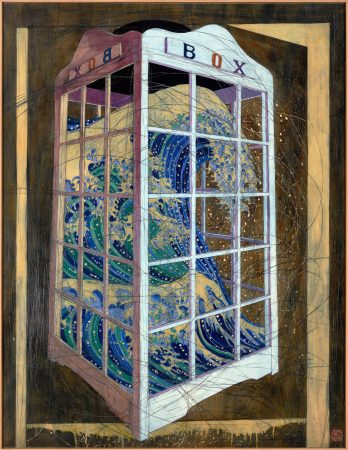
As Tokyo Gendai brings together audiences from Japan and around the world, what do you hope visitors will take away from encountering your work?
Answering these questions has made me reflect on a more fundamental one: Why do I create and exhibit my work?
I believe it is because I hope my work can become a place where people discover the joy of sharing a common appreciation for art—and, beyond that, a space where they can feel grateful for the richness of human culture itself.
To me, a work of art is not valuable simply because it is famous or expensive. I want people to trust their own intuition when they look at a work. Culture comes first. It creates connections between people, and upon that foundation, society and the economy are built.
That is why I hope visitors to Tokyo Gendai, an international platform for art, will come away with a renewed sense of how essential culture is to our lives.
Ukiyo-e and woodblock printing stand at the very origins of Japanese art, yet they also possess profound cultural significance on a global scale. My intention is not simply to preserve that tradition, but to carry it forward by infusing it with a contemporary sensibility and my own vision of the universe.
Whether visitors come from Japan or from abroad, I hope my work offers an opportunity to experience the richness of human imagination, the enduring value of culture, and the joy of sharing art with one another.
Thank you very much! We look forward to seeing your work in September.
Experience Seiko Kawachi’s new universe of woodblock prints.
Dates:
11-13 September 2026 (Fri-Sun) *Vernissage: 10 September (Thu)
Venue:
Pacifico Yokohama
Booth:
The Tolman Collection
Ticket Purchase:
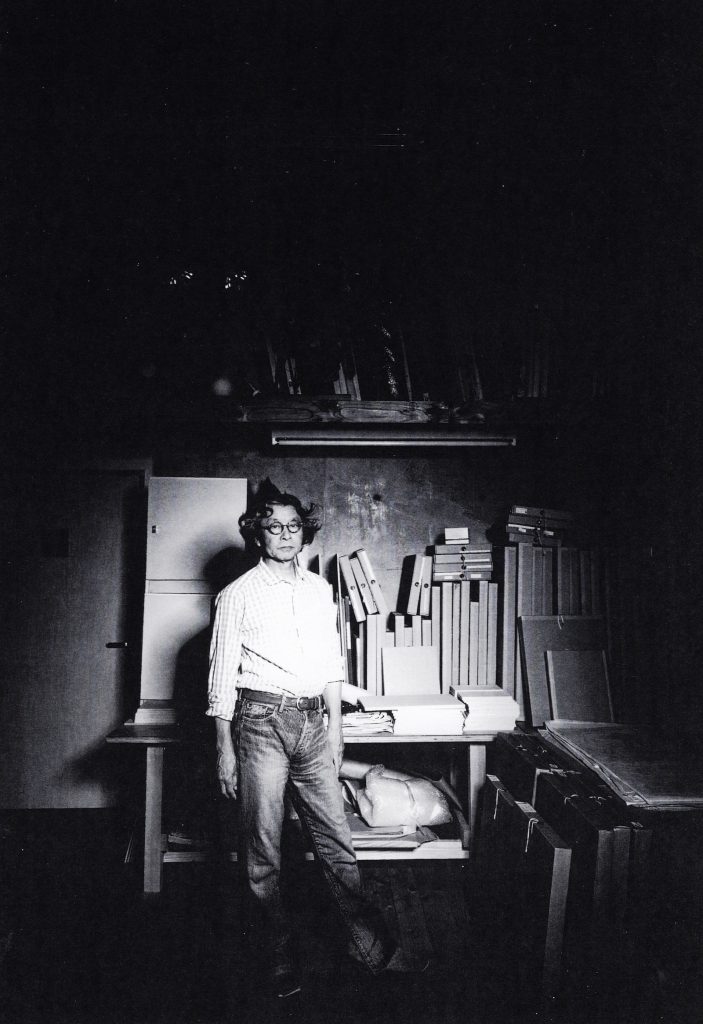
Seiko Kawachi (b. 1948, Yamanashi, Japan) is one of the leading figures in contemporary Japanese woodblock printmaking. He entered the Department of Oil Painting at Tama Art University and, while still a student, received the New Artist Award at the 38th Japan Print Association Exhibition in 1970. In 1985, he was awarded a grant by Japan’s Agency for Cultural Affairs to study abroad as an Overseas Research Fellow, spending a year at Columbia University in New York. During this period, he came to recognize ukiyo-e as the foundation of Japanese art, an insight that has profoundly shaped his practice.
Grounded in a deep respect for Katsushika Hokusai and the artistic and cultural legacy of the Edo period, Kawachi regards printmaking as a means of capturing and reflecting the world. Through his distinctive woodblock printing technique, which combines relief and intaglio processes, he creates richly textured surfaces that express the dynamic forces of waves, Mount Fuji, the cosmos, and life itself with vivid color and fluid, expressive lines.
While inheriting the spirit of traditional Japanese woodblock printing, Kawachi continually expands its possibilities through a contemporary visual language characterized by a strong sense of movement and layered spatial depth.
In 2011, he was awarded the Medal with Purple Ribbon by the Japanese government in recognition of his artistic achievements. His works are held in the collections of the British Museum, the Cleveland Museum of Art, and the National Museum of Modern Art, Tokyo, among many others.