
Keita Morimoto creates paintings that capture the quiet moments of everyday life and fleeting impressions of light through his distinctive artistic vision.
His works evoke a sense of familiarity, yet depict places that seem to exist only beyond reality. The glow of lights suspended in the night, landscapes preserved in memory, and imagined spaces all converge to form scenes that are both intimate and elusive. Each painting invites viewers to connect their own memories and emotions with these imagined worlds, offering a renewed perspective on the everyday.
In this conversation with Tokyo Gendai Fair Director Eri Takane, Morimoto reflects on the ideas and motivations behind his practice, as well as the direction of his future work. We invite you to experience the quiet depth and subtle atmosphere of his paintings at the fair.
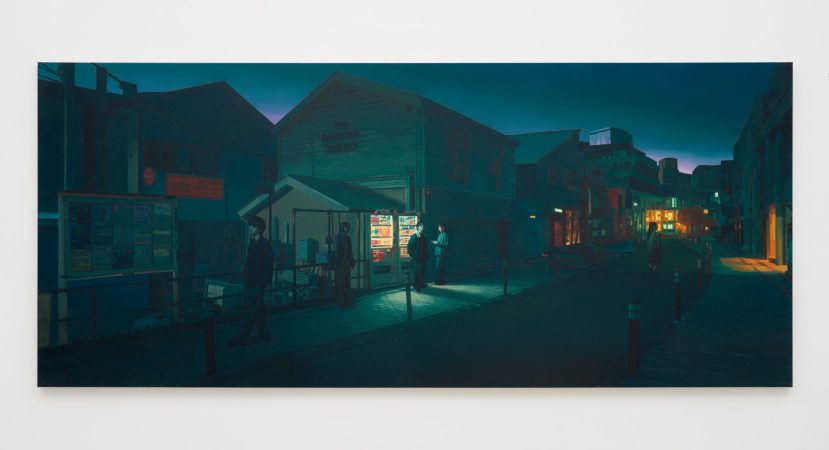
Painting Places That Feel Familiar, Yet Exist Nowhere
Eri Takane (Eri): To begin, I’d like to ask a question for those encountering your work for the first time. Tokyo Gendai welcomes not only collectors but a wide range of visitors. How would you introduce your practice to someone seeing your paintings for the first time?
Keita Morimoto (Keita): My work has evolved gradually—from before I came to Japan, to my early years here, and to where it is today. Initially, I was interested in reframing familiar everyday scenes and overlooked places, presenting them from a fresh perspective.
More recently, my practice has expanded to include spaces that do not exist in reality—fictionalised environments that emerge from imagination.
Eri: How has your work changed since moving from Canada to Japan?
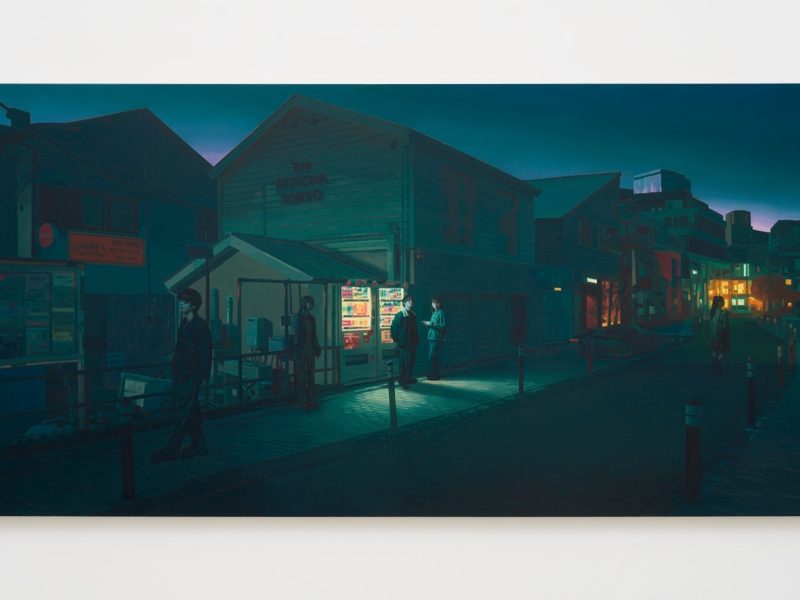
Keita: Transforming real landscapes into dreamlike spaces has always been central to my practice. Lately, however, I’ve become increasingly interested in creating scenes that feel familiar yet exist nowhere. To achieve that sense of anonymity and universality, I’ve begun constructing entirely fictional environments. That said, I still often draw from real places, editing and combining elements of existing landscapes into a single painting.
Eri: Your paintings demonstrate remarkable technical precision. How do you translate the imagined spaces, figures, and backgrounds in your mind into a finished work?
Keita: Having made many paintings over the years, and through the continuous practice of drawing and sketching, I’ve gradually developed the ability to construct entirely fictional spaces quite naturally.
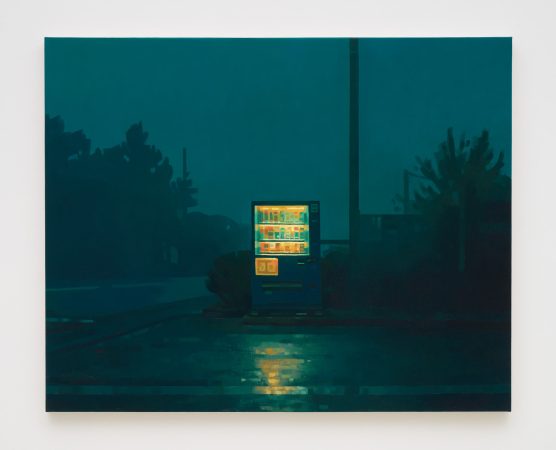
Eri: When does inspiration for your paintings usually emerge?
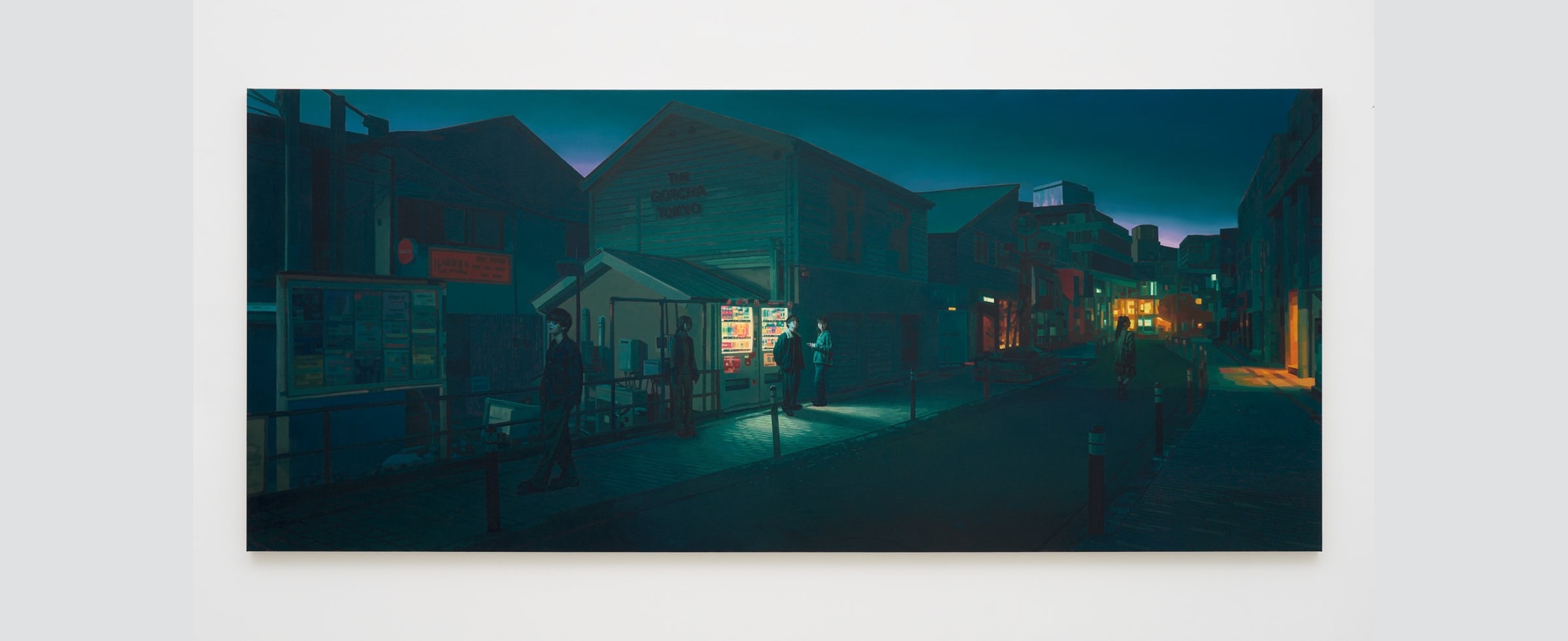
Keita: One of the first things that left a strong impression on me after arriving in Japan was the sight of vending machines at night. Seeing their glow along quiet streets brought back memories from my teenage years, when I got lost riding my motorcycle through the mountains. I remember the relief of finally spotting the light of a vending machine on my way back toward town.
In Canada, it’s rare to encounter a solitary light glowing unexpectedly in the middle of a dark road. In Japan, however, the illuminated vending machine has become an iconic part of the landscape for me.
That experience prompted me to think more deeply about Japan—its culture and its visual language—and it has had a profound influence on my practice. I’m often drawn to moments of subtle dissonance, or things that feel strangely familiar yet entirely new. To find those moments, I frequently take long walks through the city at night.
Light as a Reflection of Society
Eri: Light at night is one of the most distinctive elements in your paintings. International collectors often remark that your use of light and shadow evokes a uniquely Japanese atmosphere. How do you think about light in your work?
Keita: I began exploring light as a central theme around the time I graduated from university in Canada. In the Western art historical tradition, light has long symbolised the sacred. Today, however, light is just as often employed commercially—in advertising, for example—as a way of attracting attention. I became fascinated by that shift, and by its underlying irony.
One example that stayed with me was a statement attributed to the founder of McDonald’s, expressing the idea that he wanted people to come to McDonald’s on Sundays instead of going to church. The symbolic light once associated with the church’s cross is gradually replaced by the glow of corporate logos. There’s something unsettling—even violent—about that idea, yet at the same time I find it a compelling metaphor for contemporary society.
Eri: That’s fascinating. It really is a striking way of thinking about the values and symbols that define contemporary life.
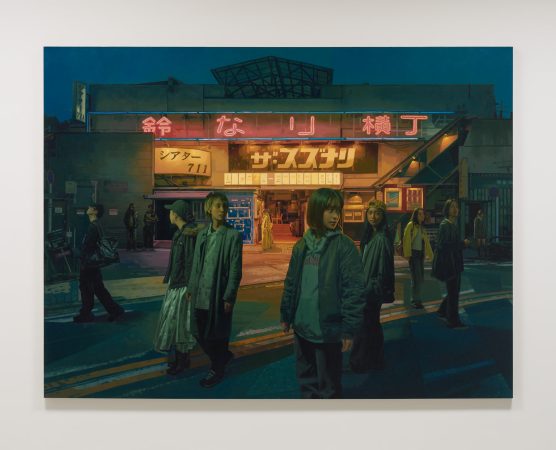
Art Can Shift the Way We See the World
Eri: Earlier you mentioned that you’ve recently begun painting entirely fictional landscapes. What kind of experience do you hope viewers will have when engaging with your work?
Keita: I feel that a metropolis like Tokyo has its own kind of gravitational pull—an invisible force that profoundly shapes the way people think and feel. I find myself caught up in that atmosphere at times as well. Walking through the city at night and painting are ways for me to step back and look at things from a broader, more detached perspective.
I believe art has the power to offer new ways of seeing—to shift our perception of reality, even if only slightly. If my paintings encourage people to notice the small, easily overlooked moments in everyday life, I would be very happy.
Creating Spaces Between Reality and Fiction
Eri: Is there anything new you’d like to explore in the future?
Keita: At my recent solo exhibition, I presented an installation for the first time. I transformed a second-hand vending machine and incorporated ceramic bottles and paintings within it. By working beyond the two-dimensional surface and introducing sculptural elements, I’m experimenting with ways of creating spaces that move fluidly between reality and fiction.
New Works at Tokyo Gendai
Eri: You have exhibitions planned both in Japan and internationally this year. What can visitors look forward to seeing at Tokyo Gendai this September?
Keita: I’ll be presenting two large-scale paintings that I created for the key visual of the Omotesando Hills 20th Anniversary Project, produced by Hiroshi Fujiwara in May 2026, one of which will be shown to the public for the first time as an original painting.
Looking ahead, I also have an exhibition planned in Paris next year, along with a major exhibition in Japan.
Eri: That sounds very exciting. We look forward to seeing the new works.
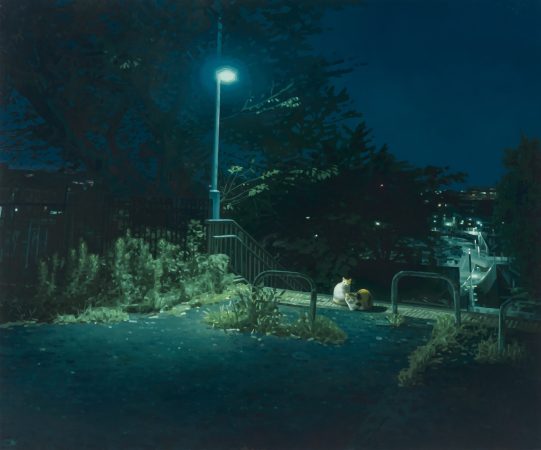
Seeing Japan Through the Experience of Living Abroad
Eri: You spent many years working in Canada and have now been back in Japan for around five years. Have you noticed differences between the art scenes and audiences in Japan and overseas?
Keita: Around the time I returned to Japan, interest in contemporary art here was growing very rapidly. It felt as though a momentum that had begun in North America was spreading across Korea, Taiwan, and Japan.
More recently, however, things have settled down somewhat, and there are increasing opportunities to encounter emerging artists.
What I’ve come to appreciate is that Japanese contemporary art, in a positive sense, doesn’t try too hard to conform to international trends. In the past, that was sometimes criticised as a weakness, and I have to admit there was a time when I agreed with that view to some extent. Now, though, I feel that this slightly “Galápagos-like” quality is precisely what allows uniquely Japanese and genuinely original work to emerge.
Eri: You’ve participated in Tokyo Gendai every year. What are you most looking forward to this year?
Keita: Discovering new artists, without question. What I enjoy most about local art fairs is the chance to encounter talented artists who are deeply rooted in the place where they’re exhibiting.
Eri: This year, around sixty percent of the participating galleries are international and forty percent are from Japan. We’ll also be introducing many younger artists who are still relatively unknown in Japan. I think it will be an exciting programme for both local and international visitors.
Keita: I’m really looking forward to it.
Moved by Worlds I Could Never Paint Myself
Eri: Do you often have opportunities to interact with other artists?
Keita: I meet artists through the gallery, but interestingly, the artists I admire the most are often the ones I feel a little hesitant to approach. (Laughs.) Perhaps it’s because I respect them so much.
Eri: What kind of work are you most drawn to?
Keita: Mostly painting. I’m also attracted to material-based practices, such as craft, but what they all have in common is that they present a world I could never create myself.
Lately, I’ve often thought about something Takashi Murakami once said—that we’re moving “from grand narratives to small narratives.” I think that’s something we’re seeing in the art world today as well. Rather than addressing sweeping social themes, many artists are focusing on deeply personal stories and intimate worlds. In many ways, that also reflects the age of social media, where people’s interests have become increasingly fragmented and individualised.
Eri: That’s a fascinating perspective. I hope this year’s Tokyo Gendai will offer exactly those kinds of discoveries.
Keita: I’m very much looking forward to it.
Eri: Thank you very much for your time today. We’re excited to see your work at Tokyo Gendai.
Keita: Thank you. It’s been a pleasure.
Thank you very much! We look forward to seeing your work in September.
Step Into Keita Morimoto’s Unseen Landscapes.
Dates:
11-13 September 2026 (Fri-Sun) *Vernissage: 10 September (Thu)
Venue:
Pacifico Yokohama
Booth:
KOTARO NUKAGA
Ticket Purchase:
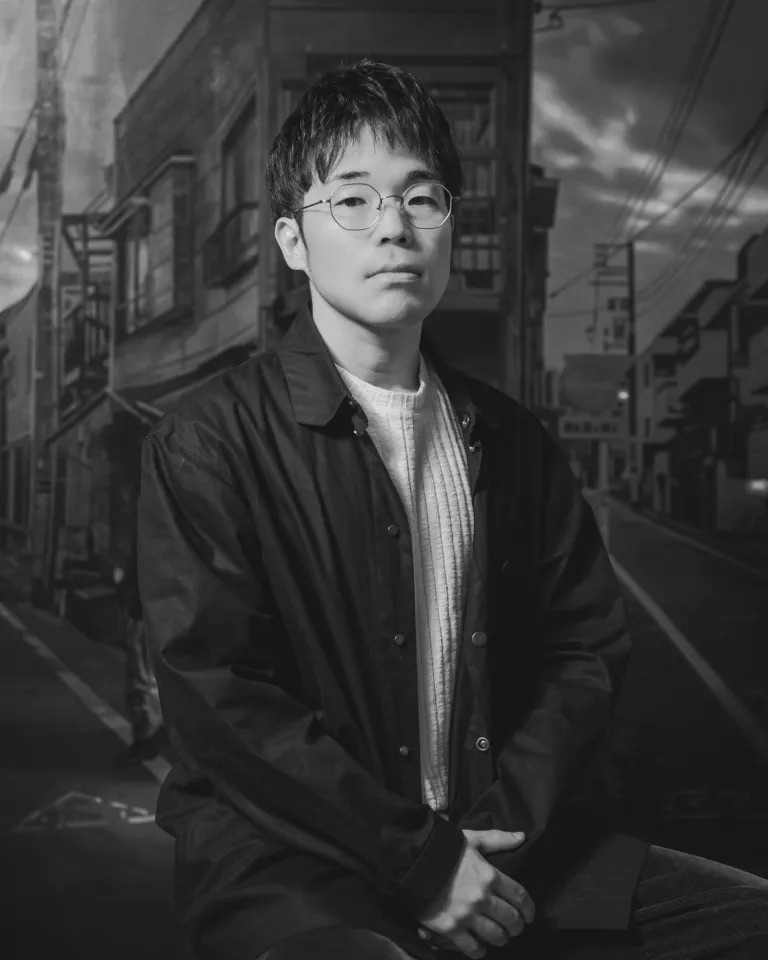
Keita Morimoto
Born in Osaka in 1990, Keita Morimoto moved to Canada in 2006 and graduated from the Ontario College of Art and Design University (OCAD University) in 2012. After establishing his artistic practice in Canada, he returned to Japan in 2021 and is currently based in Tokyo.
Deeply influenced by Baroque painting, early 20th-century American Realism, and traditional genre painting, Morimoto draws on these historical traditions to transform seemingly ordinary scenes of contemporary urban life into evocative and narrative-driven compositions. Through his symbolic use of light, he creates works in which the depth of history resonates with the complexities of the present.
In 2025, Morimoto presented the solo exhibition what has escaped us at the 21st Century Museum of Contemporary Art, Kanazawa. His work has been exhibited at institutions including the Museum of Contemporary Art Toronto, K11 MUSEA, Long Museum, Art Gallery of Peterborough, The Power Plant Contemporary Art Gallery, and the Fort Wayne Museum of Art. His works are held in collections including the Shiga Museum of Art, Kyoto City KYOCERA Museum of Art, Arts Maebashi, the High Museum of Art (USA), Fondazione Sandretto Re Rebaudengo (Italy), and the Institute of Contemporary Art, Miami (USA).