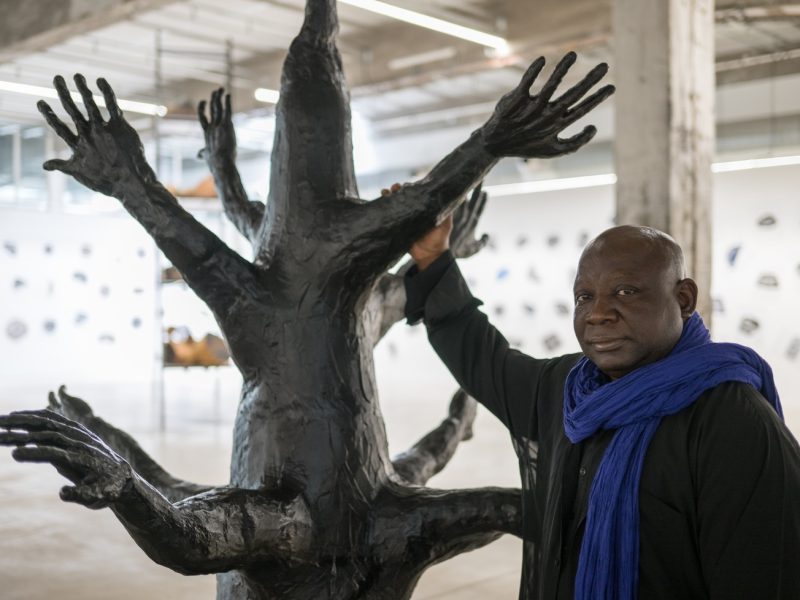

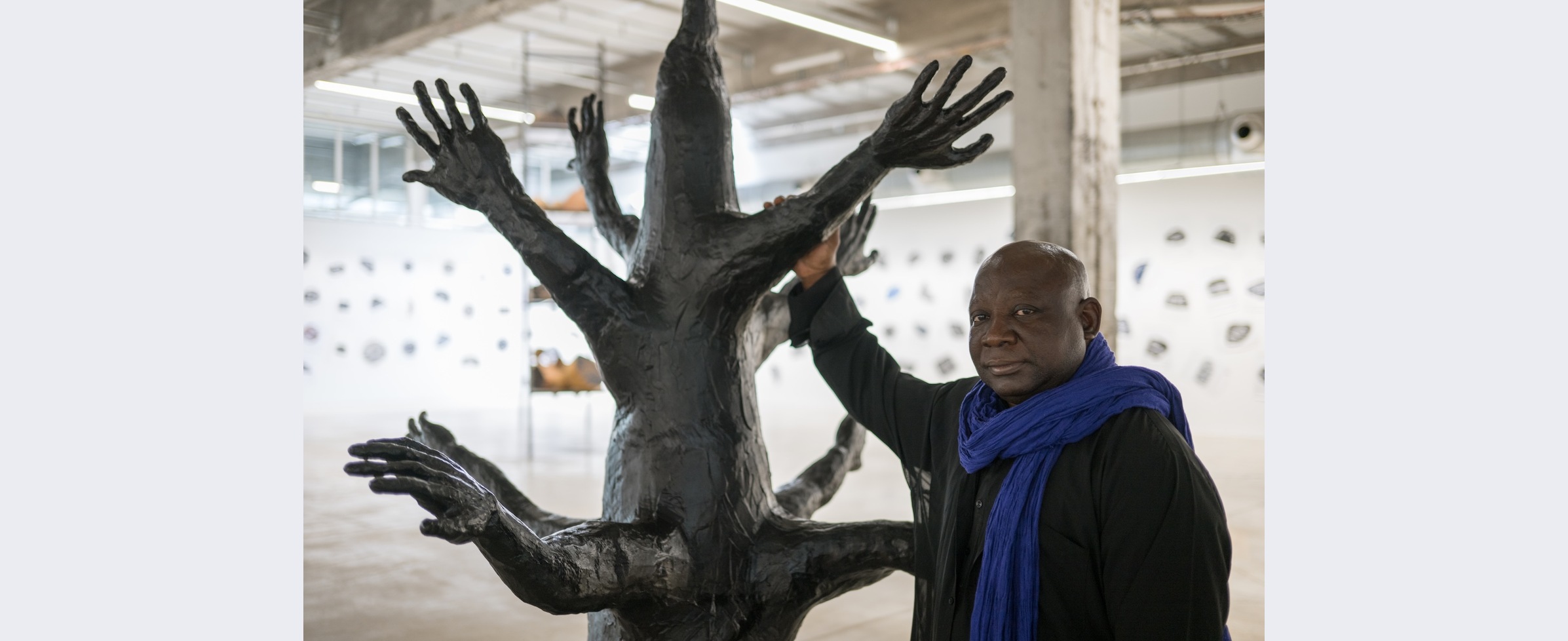
Born in Cameroon and now based between Paris and Bandjoun, Cameroon, Barthélémy Toguo has built an internationally acclaimed practice spanning painting, sculpture, printmaking, performance, and installation. Through these diverse mediums, he explores themes of migration, borders, human dignity, and the relationship between society and nature. His work has been exhibited at major international exhibitions, including the Venice Biennale, and in 2021 he was appointed a UNESCO Artist for Peace. Toguo also founded Bandjoun Station, a cultural center in his hometown that connects art with local communities through artist residencies and agricultural initiatives.
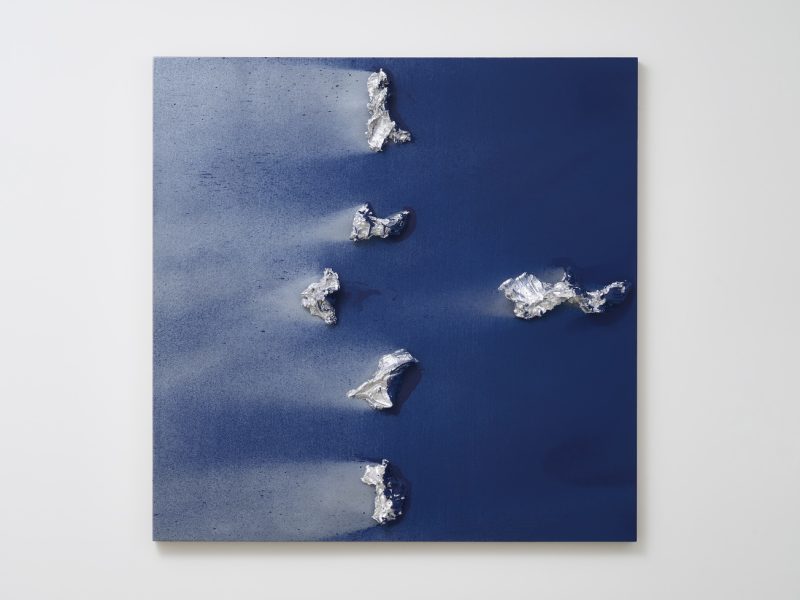
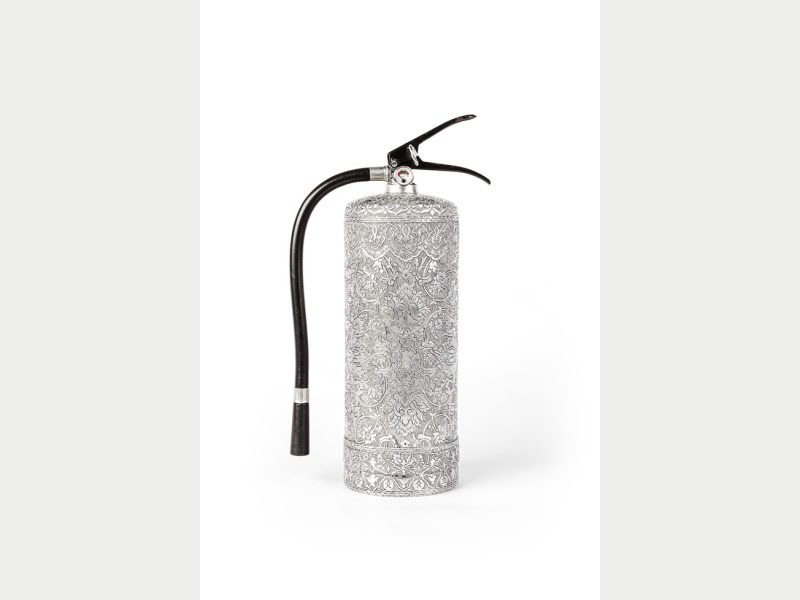
At Tokyo Gendai, visitors will have the opportunity to experience a compelling glimpse into the breadth of his practice. Woven from motifs of the body, plants, and symbolic imagery, his works quietly resonate with each viewer’s own memories and experiences, inviting new forms of dialogue.
In this interview, Toguo reflects on the ideas that underpin his artistic practice and the perspective on the world that continues to shape his work.
For those encountering your work for the first time, could you introduce your artistic practice and the essence of your work?
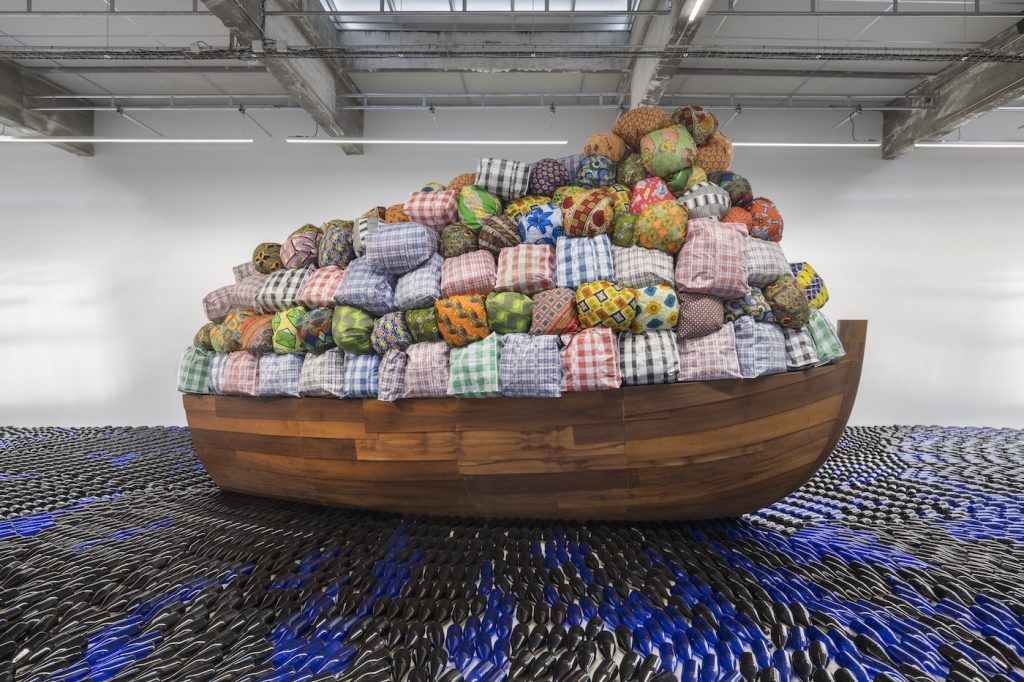
I could say that my work began the day I left Cameroon. My body crossed borders, and I quickly realized that the simple act of travelling did not carry the same meaning for everyone. Between airport queues, suspicious glances, and humiliating border controls, I became aware that my passport, the colour of my skin, and my origin were already constructing a story about me before I had even spoken. That is where my artistic practice took root: in this physical and psychological experience of the border.
When I paint, engrave, or create installations using suitcases, passport stamps, or passports themselves, I am not speaking about an abstract concept. I am speaking about what I have lived as a Black man moving between Africa and Europe, between the Global South and the Global North. The fragmented bodies, distorted faces, and waiting figures that appear in my work are transformed memories—experiences absorbed over time, yet still deeply intimate.
At the same time, I have always had a very direct relationship with making. As a child, I was constantly drawing, shaping objects, building things. Later, painting, watercolour, ceramics, and performance became languages through which I could express what words alone could not. I need to touch materials—to feel the paper absorb water, the resistance of clay beneath my fingers, the heat of the kiln. It is through this almost physical relationship with matter that my personal history finds its form.
Ultimately, my work is a fragmented autobiography. It speaks of my journey, my struggles, and my attachments, while opening them up to the experiences of others. I try to transform my own experiences into shared images, where everyone can project their own memories, their own borders, and their own hopes.
You founded Bandjoun Station, an art centre in Cameroon where you develop projects combining agriculture and artistic creation. How do these social and community-based initiatives influence your own artistic practice?
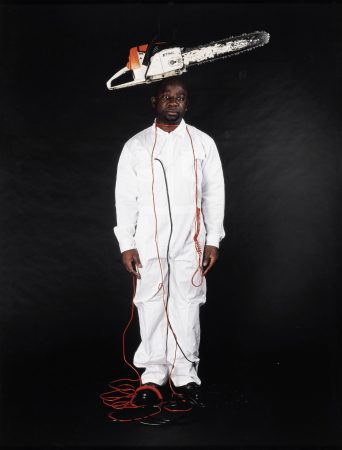
Bandjoun Station was born from something deeply personal. When I began exhibiting in Europe, travelling, and working with major institutions, I felt a profound sense of rupture. I came from a village, from a country where there were so few places to experience contemporary art, to learn, and to engage with ideas and critical debate. Suddenly, I found myself surrounded by museums, foundations, and private collections. I asked myself: What am I giving back to the place I come from?
Creating Bandjoun Station was my way of answering that question. I wanted the young person I once was in M’Balmayo or Bandjoun to be able, one day, to walk into a place where they could encounter works by their contemporaries—from Africa, Europe, and the Americas—and say to themselves, “This concerns me. I, too, can speak to the world.” That motivation is deeply personal. It is my way of addressing something I felt was missing in my own journey.
Agriculture is even more intimate. I come from a culture where the land is ever-present—in our stories, our food, and our everyday gestures. Returning to work the land in Bandjoun—planting, harvesting, exchanging with farmers—reconnects me with a part of my childhood. It calms me and grounds me. When I return to the studio afterwards, I am no longer carrying only theoretical debates about art; I also carry the smell of the earth, the sound of rain falling on the fields, and the fatigue of bodies that have worked the land.
All of this nourishes my artistic practice because it reminds me that art must never become disconnected from real life. Bandjoun Station is not a backdrop; it is a living place where my own biography intersects every day with those of the local community and the artists we welcome. My works carry these accumulated layers of experience. They emerge as much from the great cities of the Western world as they do from the fields, the hills, and the markets of my homeland.
Motifs such as body parts, plants, and boundary lines frequently appear in your work. In the context of space Un’s curatorial theme, “A Map-like Journey,” how would you define the notion of a “map”? Beyond a simple geographical boundary, how do you see a map as a way of revealing the movements of human identity and the soul?
When I think of a map, I first think of the ones I have had to confront throughout my life: visa application forms, airport maps, administrative documents that locate you, classify you, authorize you, or deny you passage. These are very cold maps, yet they have shaped my life in tangible ways. Perhaps that is why lines, borders, and fragmented bodies appear so often in my work—they are traces of those imposed divisions.
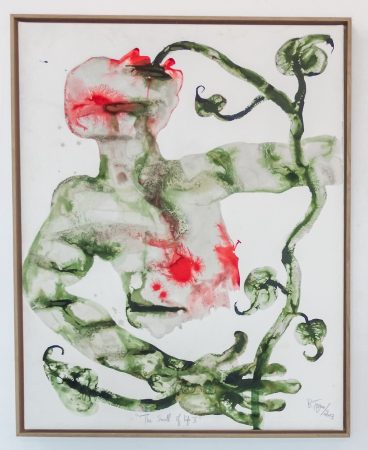
At the same time, I carry within me other maps that are much older: the map of my village, the paths we followed as children to fetch water, the trees that served as landmarks, the places where our ancestors rest. These maps are not drawn on paper; they are inscribed in the body and in memory. When I paint plants overtaking human figures, or veins that resemble roots, I am in fact drawing these intimate geographies.
Within the context of A Map-like Journey, I would say that a map is first and foremost a lived experience before it is an image. Every scar, every encounter, every exile becomes a kind of line traced onto our inner landscape. My works are often attempts to make these invisible maps visible: the map of a migrant who has crossed the sea, the map of an African student stopped at a border, the map of a manuscript threatened with destruction, the map of a child discovering a book for the first time.
I am not trying to faithfully represent countries or continents; I am trying to give form to inner journeys. If my work can help us understand that our identities are shaped by movement, rupture, and renewal—not simply by fixed origins—then the map becomes a tool for reading the movements of the soul, not just the boundaries of nations.
What is the most inspiring moment for you during the creative process?
For me, the most powerful moment is often when I am alone in my studio late at night, after the noise of the world has quieted down. There is a kind of shift that takes place. I begin thinking about something very concrete—a face I encountered in a refugee reception centre, a conversation with a farmer, an image of migrants on television—and suddenly I feel that it needs to take another form, something beyond the painful memory itself.
There is also another moment, one that is more physical. It happens when I begin a large drawing or watercolour, when the first lines appear and the water spreads across the paper, beyond my control. It is something deeply visceral. Sometimes, in the movement of my hand, I recognize an old emotion, a wound I had not yet fully processed. At that moment, inspiration is not comfortable; it confronts me with myself—with my fears, my anger, and my vulnerability.
With ceramics, that intensity becomes even greater. Placing a monumental piece into the kiln, not knowing exactly how it will react, waiting, opening the kiln… it is a moment of truth. There is always the possibility of failure, of breakage, of the unexpected. It reminds me very much of the life of a migrant who does not know what awaits on the other side of the border.
Perhaps the reason I continue to create is that I am still searching for that moment when the unknown emerges through the material and whispers to me: “Here—you are alive.”
At Tokyo Gendai 2026, space Un’s booth will present an exhibition under the theme “A Map-like Journey” across the African continent. Within this curatorial framework, what perspective or dialogue do you hope your work will inspire among Japanese audiences?
I come from a place where Asia—and Japan in particular—once felt incredibly distant, almost mythical. When I first began working in China, spending time in ceramic kilns and artists’ workshops, I experienced something profound. My world was no longer confined to the Africa–Europe axis that had shaped so much of my life. It opened onto other traditions, other ways of understanding material, time, and the act of making.
Presenting my work in Japan, within the framework of A Map-like Journey, is a continuation of that opening. I hope Japanese audiences will sense that behind the sometimes unsettling images—marked bodies, borders, suitcases—there is a personal history, a biography shaped by departures, returns, disappointments, and moments of wonder. These are not distant issues; they are lived experiences, and my own life is part of that story.
More than anything, I hope to create recognition—not exoticism, but a sense of kinship.
During my residency in Japan, I became deeply interested in the kami: the spirits of water, fire, forests, and mountains. In Cameroon, we have similar spiritual figures. We call them Jengu, Nying, and Mongo ma Loba. The names are different, but their role remains the same: nature is inhabited. It is something we negotiate with, not something we seek to dominate.
Japanese people already understand this relationship. You live with Namazu, the giant catfish beneath the archipelago. When the earth trembles, it is understood as a message. In my homeland, when Mount Cameroon rumbles, it is Mongo ma Loba who speaks; the ancestors are expressing their anger. Two cultures, one shared understanding: the earth is not an object—it is a living being.
For Tokyo Gendai, I want to place Suijin alongside Jengu, Kodama beside Nying, and Ōyamatsumi alongside Mongo ma Loba. I would love for a Japanese visitor to look at Jengu and think, “I know this river. It is the Sumida.”
Our shared horizon is simple. Faced with the climate crisis, perhaps the peoples who still know how to speak with trees, water, and fire are the ones who may help us find a way forward. Animism is not simply our past—it can also be our compass for the future.
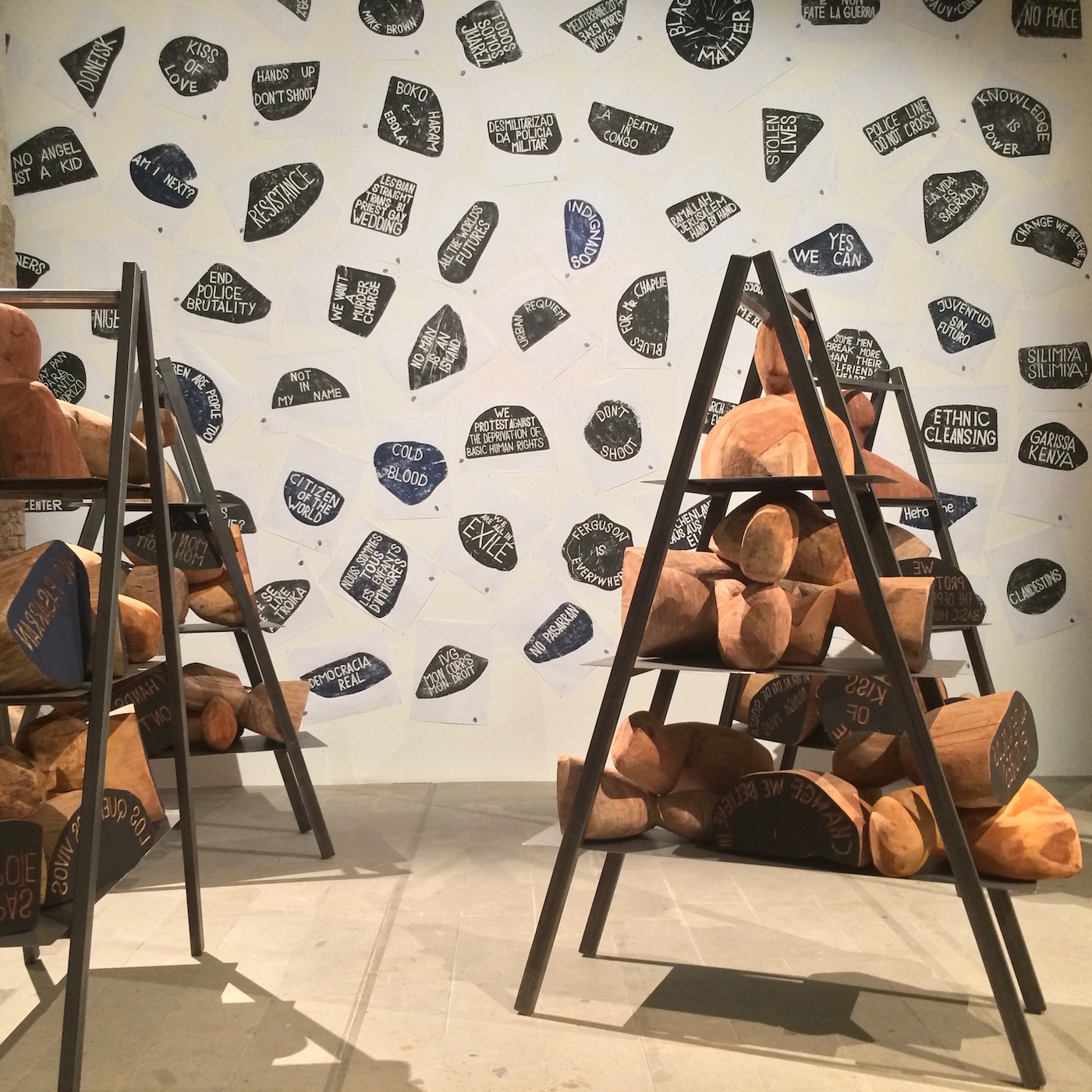
I also think about this question through very concrete experiences. When I conceived the exhibition The World as Horizon at the Bibliothèque nationale de France, I was already thinking in terms of cartography: bringing different worlds, histories, and memories into dialogue. My installation A Book is My Hope echoed the tragedy of the Timbuktu manuscripts in Mali, threatened with destruction by jihadists, while also celebrating the efforts made to preserve them, including those of the BnF. At the same time, it was important for me to include the memory of the Bilongue people of Cameroon, so that this cartography would not remain tied to a single symbolic place, but instead connect multiple African histories, voices, wounds, and acts of resistance.
In the same spirit, my series Head Above Water has been fundamental to my practice. Works such as Head Above Water – Rwanda (2011) attempt to trace an emotional map of the African continent—from north to south—through encounters with communities living with conflict, exile, and the aftermath of violence. The project is profoundly collaborative. I work with postcards, words, and symbols entrusted to me by the people I meet. These fragments are assembled into the work itself. They are not simply images of Africa; they are voices, personal stories, and memories that together form a sensitive atlas of the continent.
Within the context of A Map-like Journey at Tokyo Gendai, I hope Japanese audiences will feel that every work begins with an encounter, an exchange, a fragment of someone’s life. Whether through A Book is My Hope, the histories of Mali and the Bilongue people, or the Head Above Water series, the intention remains the same: to draw maps whose lines are not political borders, but human trajectories.
I hope visitors will allow themselves to travel—not only across space, but through memory. I want them to discover that Africa is not a single, homogeneous entity, but a constellation of peoples, languages, histories, wounds, and hopes. And perhaps these maps—made of rescued manuscripts, recovered voices, accumulated postcards, and shared memories—will resonate with the inner maps of the Japanese public: their own memories, vulnerabilities, and desire to enter into dialogue with other worlds.
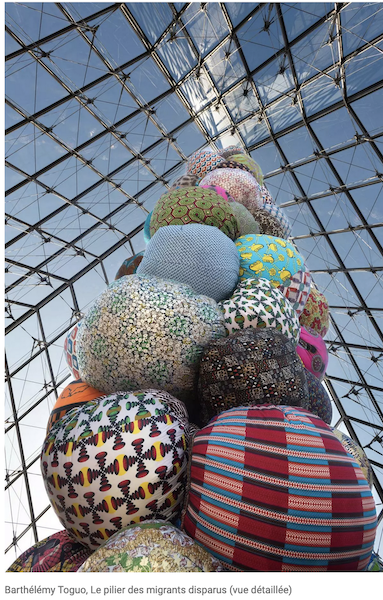
What is your view of the Japanese art scene? What are your impressions of it, and what do you hope for from Japanese audiences?
My understanding of the Japanese art scene has developed gradually, through encounters, exhibitions, reading, and conversations. What moves me most is its remarkable ability to combine extraordinary precision of gesture with a profound openness to chance, to time, and to impermanence. In calligraphy, ceramics, and many contemporary installations, I recognize a tension that I seek in my own work: the ability to shape form while allowing it to remain open to what lies beyond it.
I am also deeply touched by the way Japan lives with its difficult histories—Hiroshima, natural disasters, and the country’s profound transformations. In many ways, this resonates with me as an African. We, too, carry memories of violence, rupture, colonization, and war. The question is ultimately the same: what do we do with this memory? Do we suppress it, preserve it unchanged, or transform it into a source of creative strength?
As for Japanese audiences, more than having expectations, I hope they will approach my work with the qualities that I have come to associate with them: sensitivity, restraint, respect, and a quiet curiosity. My works do not seek to explain everything. They offer fragments of stories, symbols, and bodies in transformation. I hope each viewer will take the time to inhabit them, connecting them to their own life, their own history, and their own country.
If Japanese audiences are willing to be gently unsettled by images that come from elsewhere, while at the same time searching within them for echoes of their own history, then something deeply personal can happen—for both of us. That is what I seek today: not to persuade, but to create intimate encounters through art, from one biography to another, from one continent to another.
Thank you very much! We look forward to seeing your work in September.
Where one life connects to another. Experience Barthélémy Toguo’s work in person.
Dates:
11-13 September 2026 (Fri-Sun) *Vernissage: 10 September (Thu)
Venue:
Pacifico Yokohama
Booth:
space Un
Ticket Purchase:
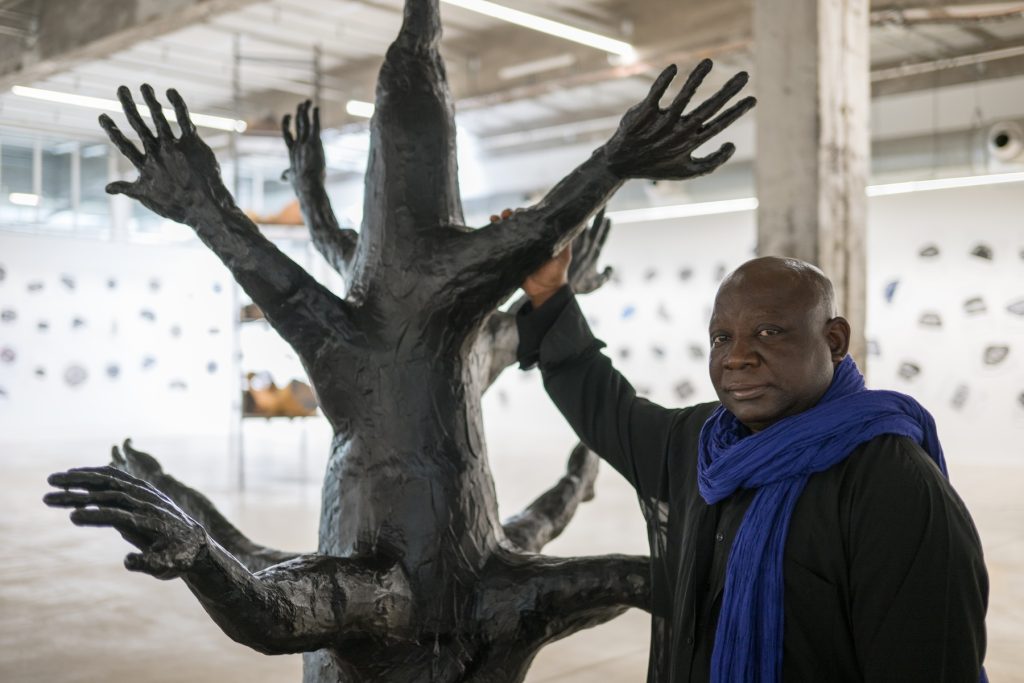
Barthélémy Toguo (b. 1967) studied at the École Nationale Supérieure des Beaux-Arts in Abidjan, followed by the École des Beaux-Arts in Grenoble and the Kunstakademie Düsseldorf. He lives and works between Paris and Bandjoun, Cameroon, where he founded Bandjoun Station in 2013, a contemporary art center and residency. He has participated in major international biennials, including Dakar, Havana, Sydney, Lyon, Venice, and Busan, and exhibited at institutions such as Palais de Tokyo (Paris), the Drawing Center (New York), Museum Ludwig (Cologne), the Louvre, and the Picasso Museum (Barcelona). His work is held in major collections including MoMA (New York), Centre Pompidou, Tate Modern (London), Fondation Louis Vuitton, and Pérez Art Museum Miami. He is represented by Galerie Lelong & Co. (Paris/New York) and Galerie Michaël Stevenson (Johannesburg/Cape Town), and collaborates with space Un, Tokyo.