
Unraveling a woven textile thread by thread, Aiko Tezuka uses this quiet and meticulous act to reveal the structures and layers of time hidden within what we perceive as a “finished” object. Beginning with painting, Tezuka has developed a practice of dismantling and reconstructing textiles and embroidery, her works inviting us to imagine time running backward and to consider the “unchosen possibilities” that might have existed along the way.
At first glance, her works may appear delicate and beautiful. Yet beneath their surface lie questions about history, society, and the fixed assumptions we carry within ourselves. Refusing to confine textiles to notions of “handwork” or “materiality,” Tezuka explores new possibilities for artistic expression through the structures inherent to the medium itself. We spoke with Aiko Tezuka about the ideas behind her practice and the new works she will present at Tokyo Gendai.
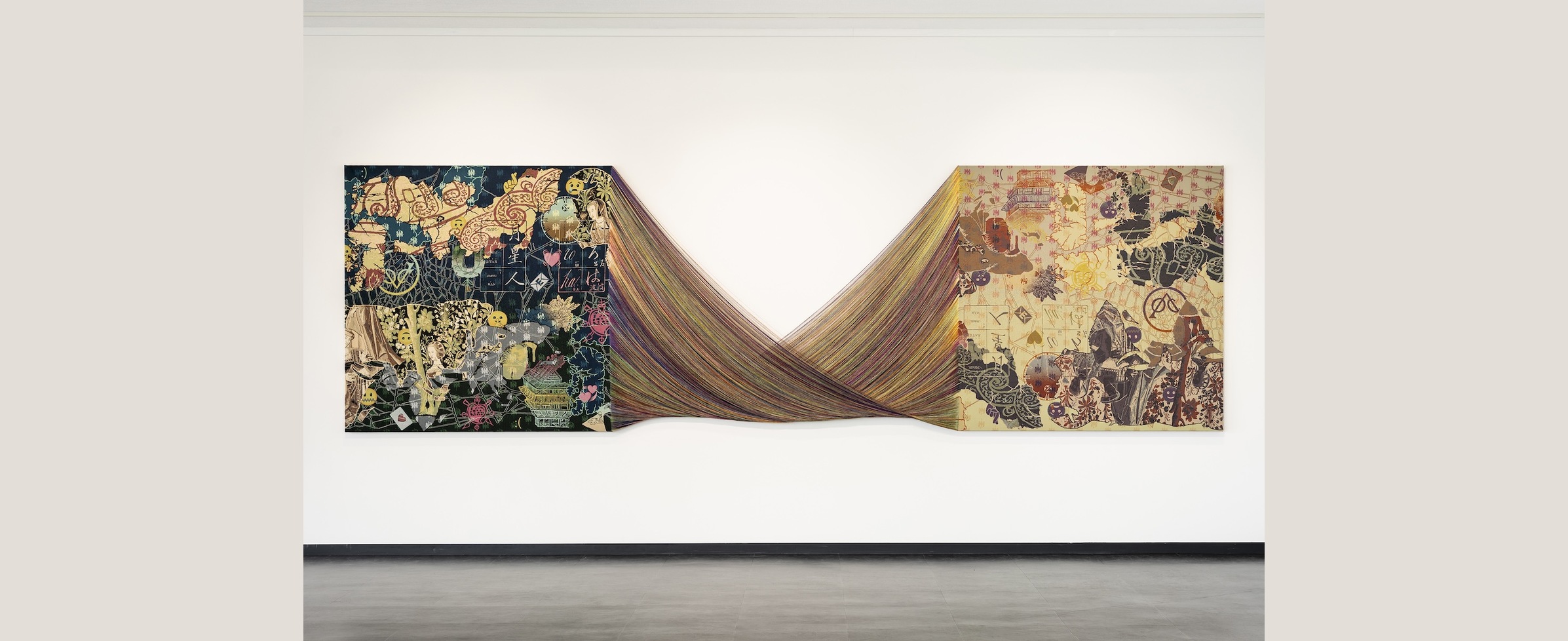
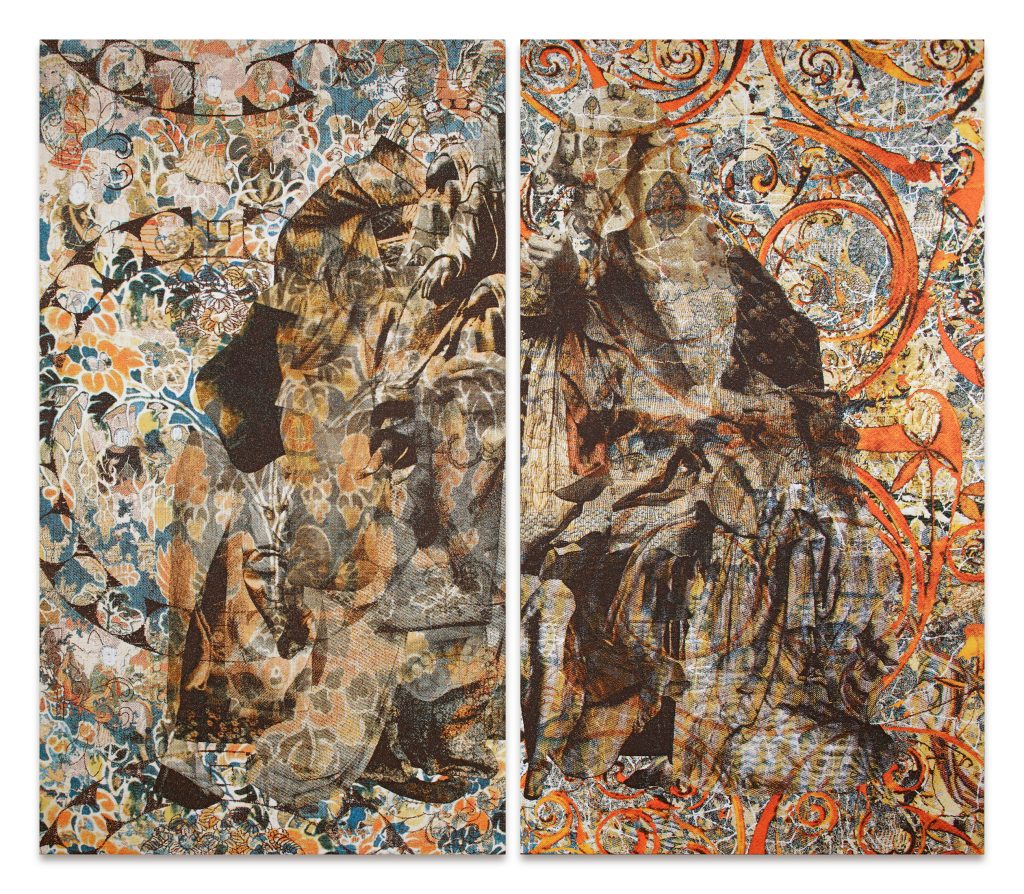
Unravelled Jacquard weaving designed by Aiko Tezuka, wooden panels
H.141.5 x W.466.7 x D.5 cm (set of two panels, panel sizes 141 x 141 cm each)
Fabric development and production by Kaji Textile Inc. (Kyoto Nishijin Textile)
Photo by Yuki Moriya
Collection of The National Museum of Modern Art, Kyoto, Japan
Unravelled Jacquard weaving designed by Aiko Tezuka, wooden panels
H.141.5 x W.466.7 x D.5 cm (set of two panels, panel sizes 141 x 141 cm each)
Fabric development and production by Kaji Textile Inc. (Kyoto Nishijin Textile)
Photo by Yuki Moriya
Collection of The National Museum of Modern Art, Kyoto, Japan
For those encountering your work for the first time, how would you describe your artistic practice?
I create works by unraveling woven structures, conceptually rewinding time, and evoking the possibilities that were not chosen along the way to the present. I am particularly interested in the gentle temporal space that emerges as structures made through weaving, knitting, embroidery, and other textile techniques return to their original materials.
I aim to create works that can instantly captivate children. But when that initial encounter gives rise to questions such as “Why?” or “How?”, I consider it essential that another door into the work is waiting to be opened. This is one of the guiding principles of my practice.
For example, when I create a work based on a textile pattern that I have designed myself, I also create a detailed text explaining the motif. Whether or not viewers choose to read it, however, is entirely up to them.
Ideally, I want to create works that people can simply enjoy and later talk about on their way home, saying, “We saw something remarkable today.,” without needing any explanation. And for those who want to know more, there should always be another door waiting to be opened.
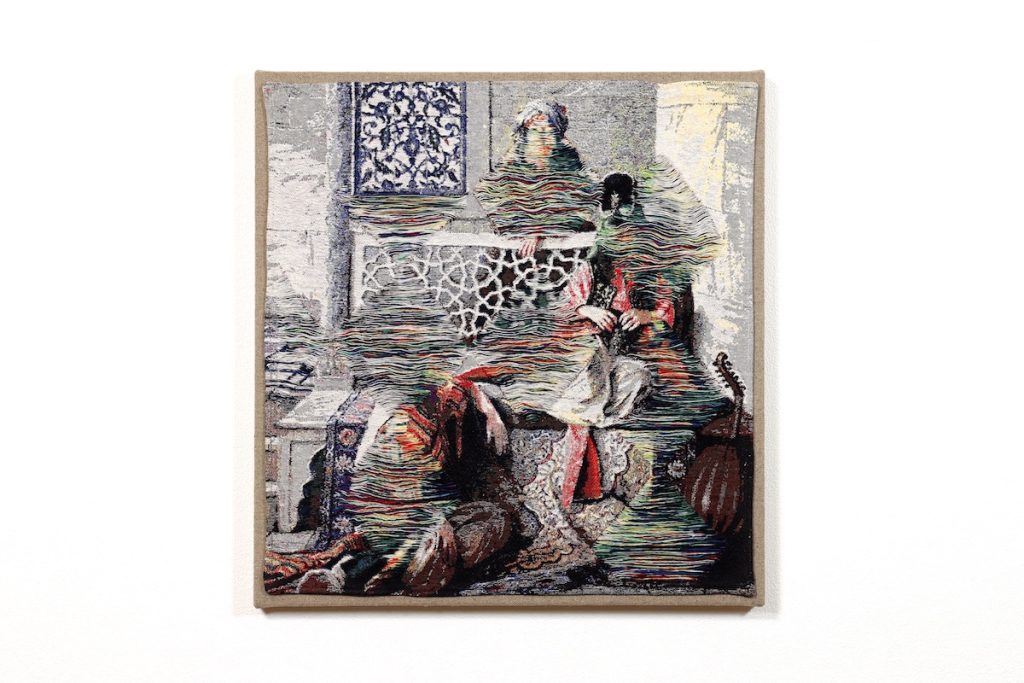
Unravelled textile, wooden panel, H. 46.5 × W. 44.2 cm
Private collection
The process of carefully dismantling existing textiles and bringing the threads normally hidden within them into view feels remarkably meticulous and meditative. As you extract each individual thread, how do you engage with the history embedded in the material, as well as with your own thoughts and ideas?
What interests me is not so much the “material itself” as the “structure” that makes weaving and embroidery possible. I am interested in giving form once again to structures that are normally hidden within a finished object and remain invisible to the eye.
In my practice, I bring together structures unique to textiles with objects and images that have emerged throughout history. Extracting a single thread is not so much an act of touching or engaging with the material itself, but a way of drawing out another kind of time—and other possibilities that might have existed—hidden within a completed form.
Your presentation at Tokyo Gendai will feature new works that offer a preview of your upcoming 2027 exhibition. These works could be seen as the culmination of highly meticulous handwork. What do you hope viewers will experience as they imagine the “tactility” of the works, extending their experience beyond the purely visual?
Viewers are free to imagine a sense of “touch” through the works. However, what I am interested in is not “materiality” itself, but the “structure” that makes textiles possible.
Words such as “tactility” and “handwork” are often used when discussing textiles. I am deeply skeptical, however, of the idea that limiting our understanding of textiles to these perspectives can narrow the possibilities inherent in the medium.
The structures of textiles enable radical forms of expression that other techniques do not offer. Structures created through “systems” such as weaving, knitting, and sewing can, in a sense, be rewound in time from their completed state and returned to their original materials. In other words, the structures hidden within a finished form can be exposed and made visible. Few forms of material construction contain such a mechanism within themselves.
“Tactility,” “handwork,” “materiality,” and even “the history embedded in the material”—these are all terms that have routinely been applied to textiles. Yet I always want to remain conscious and skeptical of whether such terms can, at times, become frameworks that limit the possibilities of the medium.
Textiles have also frequently been discussed within feminist scholarship, particularly in relation to the history of visual and material expression. This is certainly an important perspective. At the same time, I feel that when this framework alone is foregrounded, it can also narrow the range of possible interpretations of textiles.
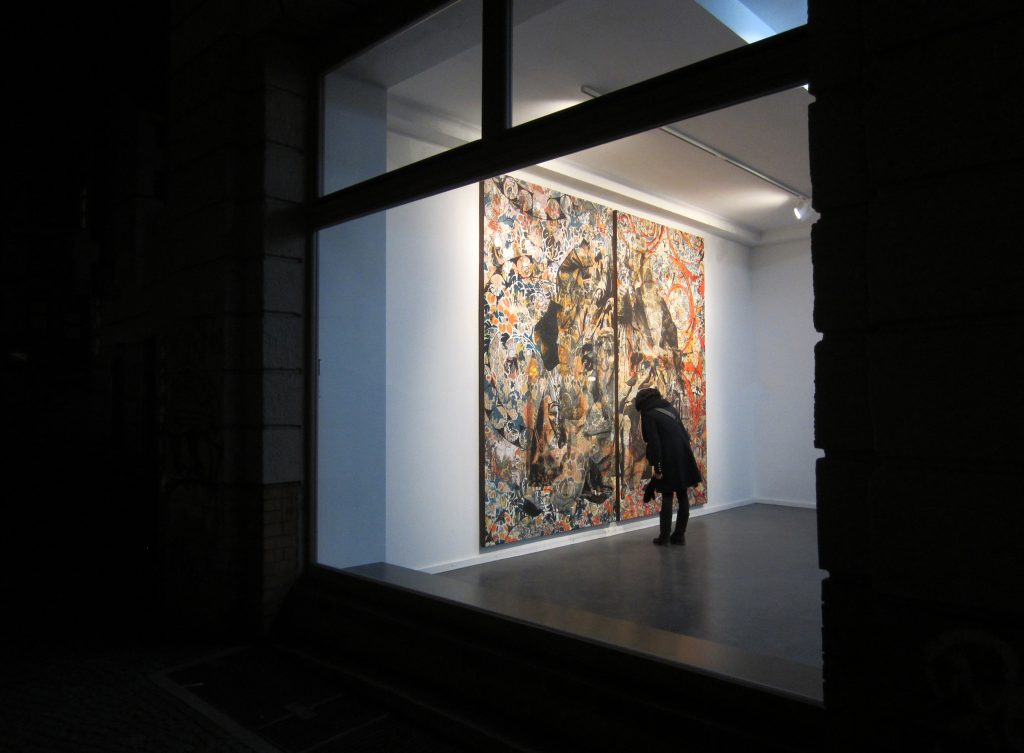
Aiko Tezuka, Ghost I Met, 2013
Multicolour Weaving “EPOTEX”
330 x 387 cm (installation), 330 x 190 cm (each), set of two
Fabric development and production by Kawashima Selkon Textiles Co., Ltd
Photo by Lepkowski Studios, Berlin, Ute Klein, Kai Magnusson
Collection of The National Museum of Art, Osaka
Aiko Tezuka, Ghost I Met, 2013
Multicolour Weaving “EPOTEX”
330 x 387 cm (installation), 330 x 190 cm (each), set of two
Fabric development and production by Kawashima Selkon Textiles Co., Ltd
Photo by Lepkowski Studios, Berlin, Ute Klein, Kai Magnusson
Collection of The National Museum of Art, Osaka
What moments inspire you most in your practice?
- When I am struck by the remarkable degree of refinement in things made in eras when there was neither electricity nor running water.
- When I imagine the relationships between those who ruled and those who were ruled in a particular period of history.
- When I think about the forces that have actually driven people throughout history, often remaining unrecorded behind the stated justifications of religion, trade, and economics—including the ways in which those forces have worked for both better and worse.
- When my own preconceptions are challenged.
- When I observe the behaviour of children and animals.
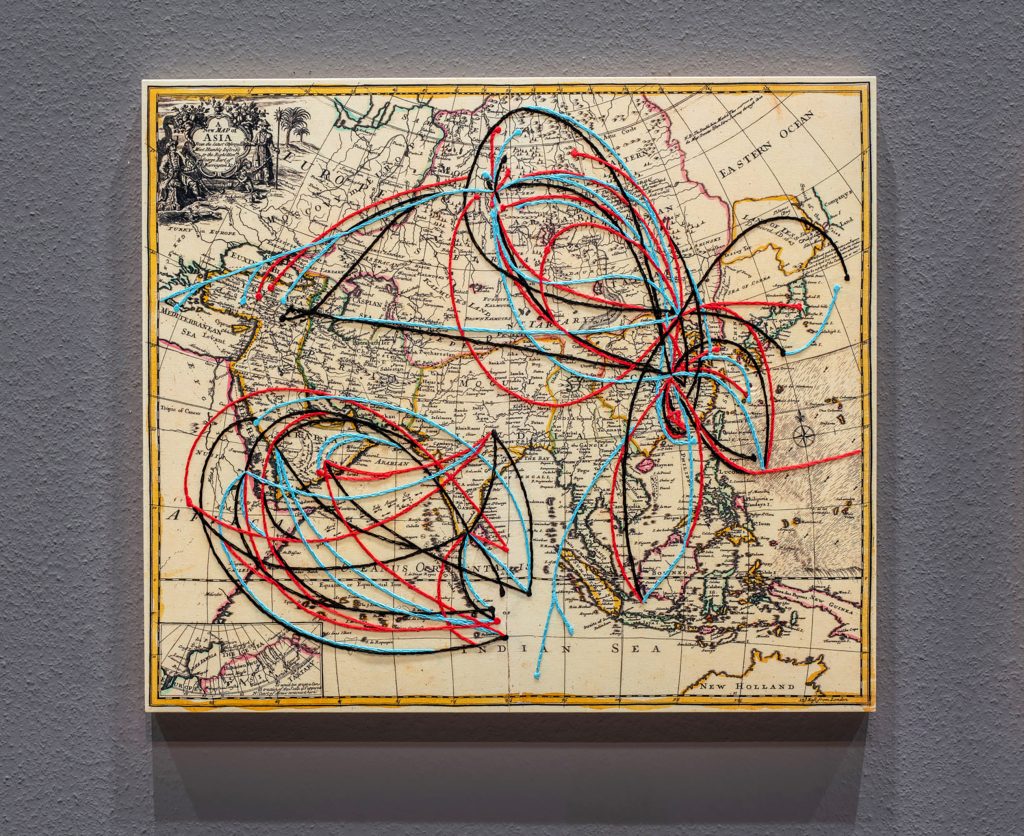
Embroidery on fabric printed with an old map, wooden panel
81.3 x 70.3 x 3 cm
Photo by ToLoLo Studio
Collection of Okazaki Mindscape Museum
What are your thoughts and expectations toward the Japanese art scene and the audiences visiting Tokyo Gendai?
I don’t have any specific expectations of viewers in advance. What I devote the greatest interest and passion to is making the work and considering how it should be installed. Once that is done, I don’t think very much about what happens to the work afterward—whether it sells or not, or who will engage with it, how they will receive it, or whether they will receive it at all. By the time one work is finished, I am already thinking about the next.
That said, an artwork is something an artist works hard to make. So I hope viewers will make an effort not only to “look” at the work, but also to “read” it. And I would like those who buy art to make an effort to buy it, too.
Thank you very much! We look forward to seeing your work in September.
What Lies Beyond the Unraveled Thread? Discover Aiko Tezuka’s Work at Tokyo Gendai.
Dates:
11-13 September 2026 (Fri-Sun) *Vernissage: 10 September (Thu)
Venue:
Pacifico Yokohama
Booth:
Kamakura Gallery
Ticket Purchase:
川瀬一絵
Aiko Tezuka
Born in Tokyo, Japan, in 1976, Aiko Tezuka lives and works between Berlin and Tokyo.
In 2001, Tezuka completed a master’s degree programme in painting at Musashino Art University, Tokyo, where she studied under the sculptor Shigeo Toya. In 2005, she completed a PhD in painting at Kyoto City University of Arts, Kyoto, where she studied under the painter Keiji Usami. From 2010 to 2011, she lived and worked in London with the support of the Gotoh Memorial Cultural Foundation. In 2011, she moved to Berlin with a fellowship from the Japanese Government’s Overseas Study Program for Artists.
In 1997, Tezuka began creating works by unravelling readymade fabrics. Since then, she has continued to develop her own methods of creating new structural forms by referencing and reconfiguring historical objects.
Her work has recently been exhibited at the National Museum of Modern Art, Kyoto; Yokohama Museum of Art; the National Museum of Art, Osaka; Contemporary Art Museum Kumamoto; Okazaki Mindscape Museum; the Museum of Contemporary Art Tokyo; Fukuoka Art Museum; Toyota Municipal Museum of Art; the National Art Center, Tokyo; Hyogo Prefectural Museum of Art (all in Japan); the National Museum of Art of Romania (Romania); the Peranakan Museum (Singapore); Stadtgalerie Kiel (Germany); the Museum of Asian Art (Berlin, Germany); Zhejiang Art Museum (China); the Rijksmuseum (Netherlands); Kunsthalle Mannheim (Germany); TextielMuseum (Netherlands); Museum für Kunst und Gewerbe Hamburg (Germany); Johann Jacobs Museum (Switzerland); the National Museum of Modern and Contemporary Art, Korea (Seoul, Korea); Turner Contemporary (UK); and Ayala Museum (Philippines), among others.