
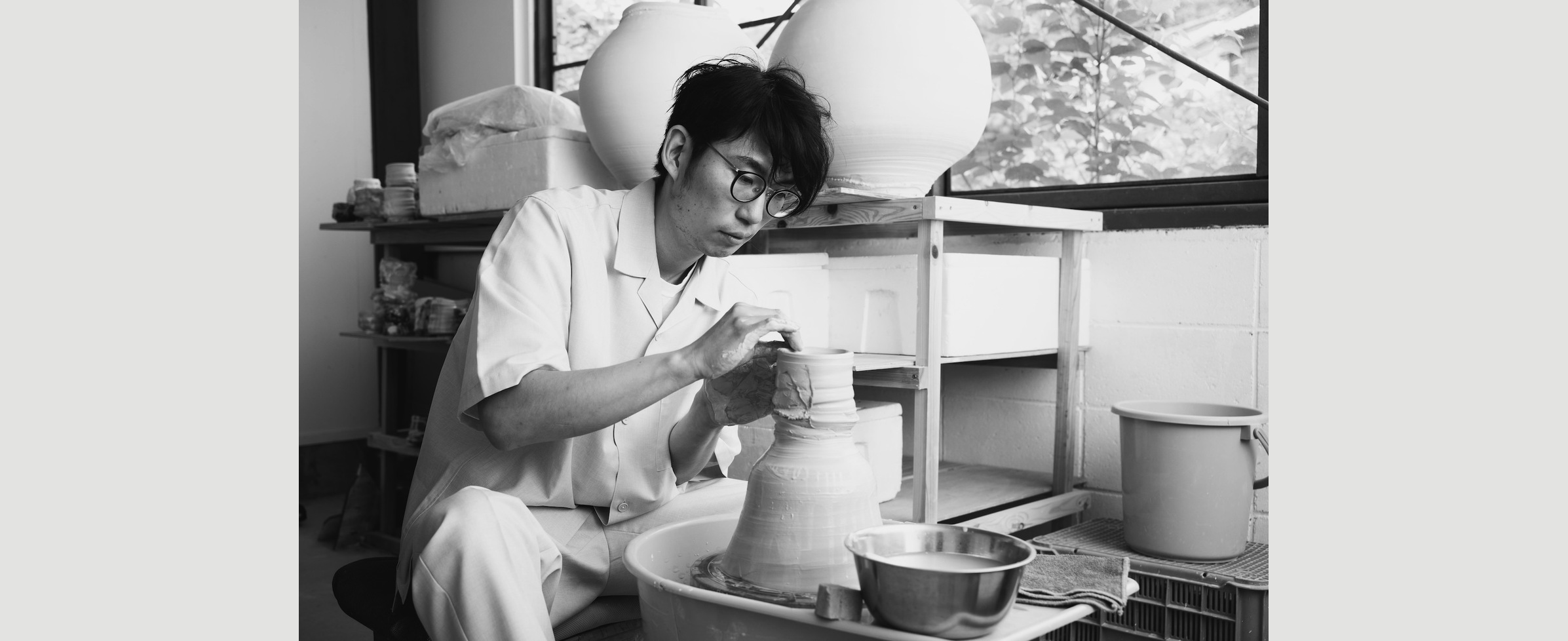
Japanese ceramics are increasingly being recognized not only as a traditional craft but also as a powerful force within contemporary art. Among the artists leading this shift is Kodai Ujiie, whose monumental ceramic sculptures have garnered international attention, with exhibitions spanning New York and beyond. Reimagining Japan’s unique aesthetic sensibility through a distinctly contemporary lens, Ujiie’s work bridges centuries of ceramic tradition with a bold, global artistic vision.
Tokyo Gendai offers a rare opportunity to experience these works in person. Standing before them, viewers encounter a striking physical presence—the texture, scale, interplay of light, and palpable sense of life that cannot be conveyed through photographs alone. In this interview, Kodai Ujiie reflects on his current artistic practice, his evolving dialogue with the international art world, and the future he envisions for Japanese ceramics on the global stage.
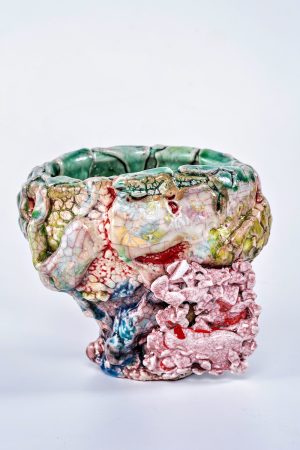
Ceramic 14.3×16.3×15.6
For people who have never seen your work before, how would you describe your artistic practice?
Through the medium of ceramics, my work explores a fundamental question: What is life?
My sculptures feature organic forms that resemble multiplying cells, along with textures that evoke skin and internal organs. Beneath these visual elements lies the Japanese philosophy of wabi.
Rather than seeing wabi as the beauty of perfection, I understand it as an aesthetic that embraces beings that are unfinished, constantly changing, and never fixed.
I call this concept “Biological Chaos Wabi.”
Life is never perfectly balanced or complete. It exists through fluctuation, scars, transformation, and imperfection. My work seeks to affirm that instability itself, capturing the very moment in which life is continuously becoming.
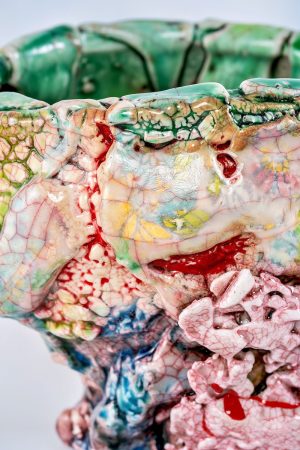
Ceramic 14.3×16.3×15.6
Your signature technique, Urushi Kannyūsai, involves staining the crackles (kannyū) in ceramics with urushi lacquer, creating vivid lines that resemble capillaries beneath translucent skin. Your work also carries a powerful sense of life and vulnerability. How have your childhood experiences—particularly the reconstructive surgery you underwent—influenced this unique technique and your organic forms?
I was born without my left ear and underwent reconstructive surgery when I was very young.
That experience left me with a strange feeling that, although this was my own body, part of it also felt like something foreign. That sensation has never disappeared, and it became the starting point for my lifelong questions: What is the body? What is life?
In Urushi Kannyūsai, urushi lacquer is absorbed into the countless crackles created during firing. These lines can be seen as blood vessels, scars, or traces that suggest life flowing beneath the surface.
Likewise, the organic, undulating forms of my sculptures are not direct representations of the human body. Rather, they express the ambiguous and unstable nature of life—constantly changing, proliferating, and blurring its own boundaries.
For me, creating art is a process of accepting the feelings of bodily discomfort and otherness that I have carried since childhood, and transforming them into a new form of beauty.
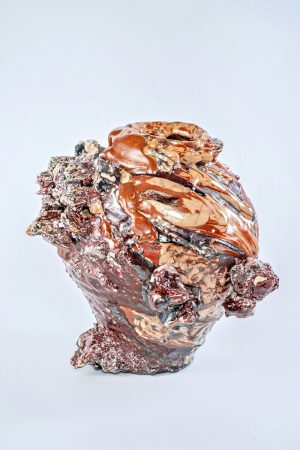
《Hybrid Nezumishino & Copper Red Glaze Jar》(2026)
Ceramic 35×37×36 cm
Your work is rooted in traditional Japanese ceramic traditions such as Kiseto and Oribe, yet it also carries the energy of contemporary fashion and street culture. How do tradition and contemporary sensibilities come together in your creative process, and when do you feel most inspired?
I draw inspiration from traditional ceramics such as Kiseto and Oribe because I want to engage in a dialogue with the origins of Japanese aesthetics.
These historical ceramic traditions embody uniquely Japanese ideas of beauty, including the philosophy of wabi. My intention is not to reproduce historical styles, but to inherit the spirit behind them and transform it into something new.
My works begin with the silhouette of traditional vessels, but gradually evolve into organic forms that appear to grow, mutate, and proliferate like living organisms. This is not an attempt to destroy tradition, but to see it as something alive—something capable of evolving.
To me, Kiseto and Oribe are not simply historical styles. They are like the DNA of Japanese aesthetics, cultivated over centuries. By inheriting that DNA while layering it with contemporary sensibilities and my own experiences, I seek to develop a new artistic language that I call “Biological Chaos Wabi.”
You have said that visiting the Miami art fairs in 2022 became a turning point, inspiring you to confront the global art world while carrying the legacy of Japanese ceramics. Since then, through solo exhibitions in New York and other international projects, how has your interpretation of Wabi-sabi and the scale of your expression evolved?
Visiting Miami in 2022 marked a major turning point in my career.
Being surrounded by contemporary art from around the world, I realized that Japanese ceramics still held enormous untapped potential within the global art conversation.
From that moment, my perspective shifted. Rather than simply introducing Japanese ceramics to the world, I began asking how Japanese ceramics could contribute something genuinely new to contemporary art.
I have also reconsidered the meaning of Wabi-sabi. Outside Japan, it is often understood as something old, quiet, or rustic. I see it differently—as a philosophy that embraces life in its constant state of transformation.
This shift in thinking has also influenced the scale of my work. In my large vessel sculptures, I want viewers not merely to look at an object, but to experience an entire living space—to feel as though they are confronting life itself.
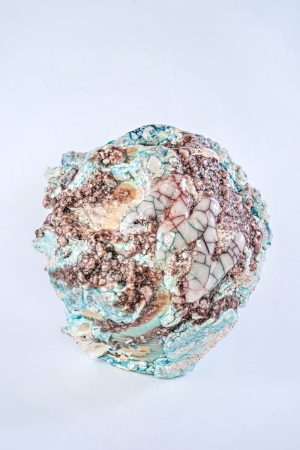
《Hybrid Oribe & White Glaze Jar》(2026)
Ceramic 38×37×35 cm $5,400
Tokyo Gendai brings together leading contemporary artists and collectors from around the world. As visitors encounter your monumental ceramic works, what message would you like to share with them and with the future of Japan’s contemporary art scene?
My work does not offer a single correct way of seeing.
Like life itself, I hope each viewer will bring their own memories, emotions, and experiences to the work, allowing it to become an opportunity for personal reflection.
I also hope to see Japan’s art scene become even more confident in engaging with the world.
Japan possesses centuries of accumulated craftsmanship and philosophy. But these traditions do not exist simply to preserve the past—they also provide the foundation for creating new values.
As an artist, I hope to continue presenting new aesthetic possibilities to the world from Japan, without being confined by the conventional boundaries of ceramics.
I look forward to beginning that dialogue through the international platform of Tokyo Gendai.
Thank you very much! We look forward to seeing your work in September.
Encounter the Living Forms of Kodai Ujiie, In Person.
Dates:
11-13 September 2026 (Fri-Sun) *Vernissage: 10 September (Thu)
Venue:
Pacifico Yokohama
Booth:
Lux Feminae
Ticket Purchase:
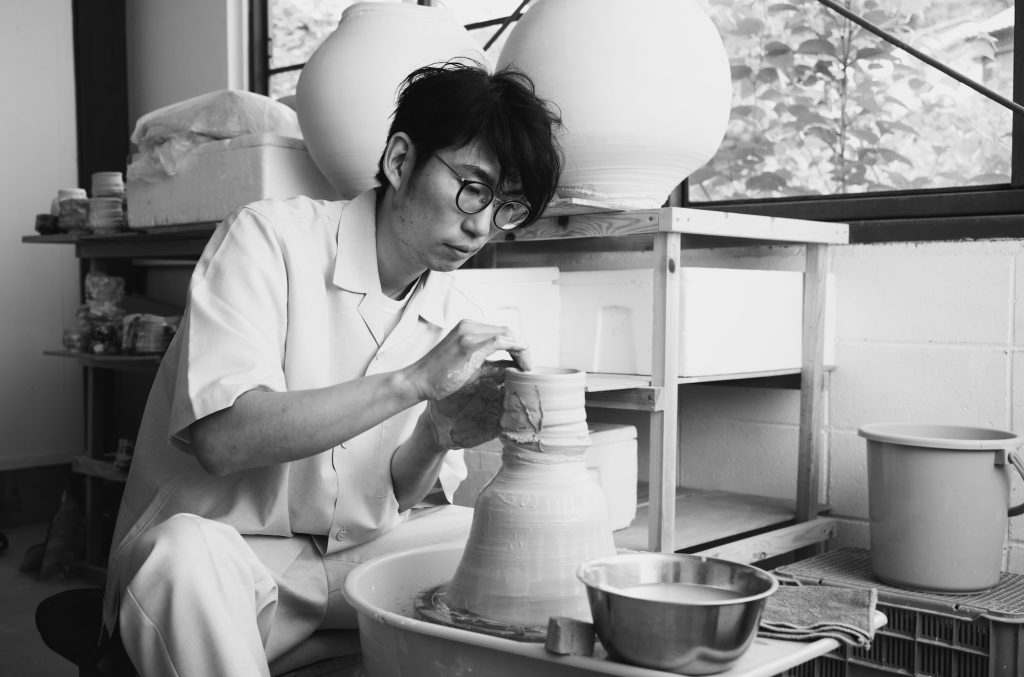
Kodai Ujiie
Kodai Ujiie (b. 1990, Japan) is a Japanese artist who received his B.F.A. in 2013 and M.F.A. in 2015 in Crafts from Tohoku University of Art and Design, Japan. Ujiie has presented solo exhibitions internationally, including at Ippodo Gallery Ginza, Tokyo; Nihombashi Takashimaya S.C., Tokyo; The Stratford Gallery, UK; Ippodo Gallery New York, New York; B-OWND Gallery, Tokyo; and Bernheim Gallery, UK. His work has also been presented at major international art fairs, including Design Miami, COLLECT, Independent, Salon Art + Design, Material, Aspen Art Fair, ZⓈONAMACO, FOG Design + Art, Design Seoul, and Tokyo Gendai. Ujiies work is held in public collections in the United States, including the Warehouse Art Museum and Seattle Art Museum.